You landed in London at 7 a.m., but every cell in your body is convinced it’s 2 a.m. back home. Your eyes are dry, your brain is foggy, and the idea of a productive day feels like a cruel joke. That is jet lag — and if you have ever dragged yourself through a business meeting or vacation morning feeling like a zombie, you know exactly how disruptive it can be.
Jet lag is far more than simple tiredness. It disrupts sleep quality, tanks cognitive focus, sours your mood, slows digestion, and can even weaken your immune response during travel. For frequent flyers, business travelers, remote workers crossing time zones, and vacationers trying to make every hour count, jet lag is not just uncomfortable — it is costly.
The good news? Your internal body clock is not a fixed, immovable thing. It is a biological system that responds to specific, well-studied cues. With the right strategies applied at the right times, you can dramatically shorten jet lag recovery and spend more of your trip feeling like yourself. Here is everything the science says you need to know.
Section 1: How Your Circadian Rhythm Actually Works
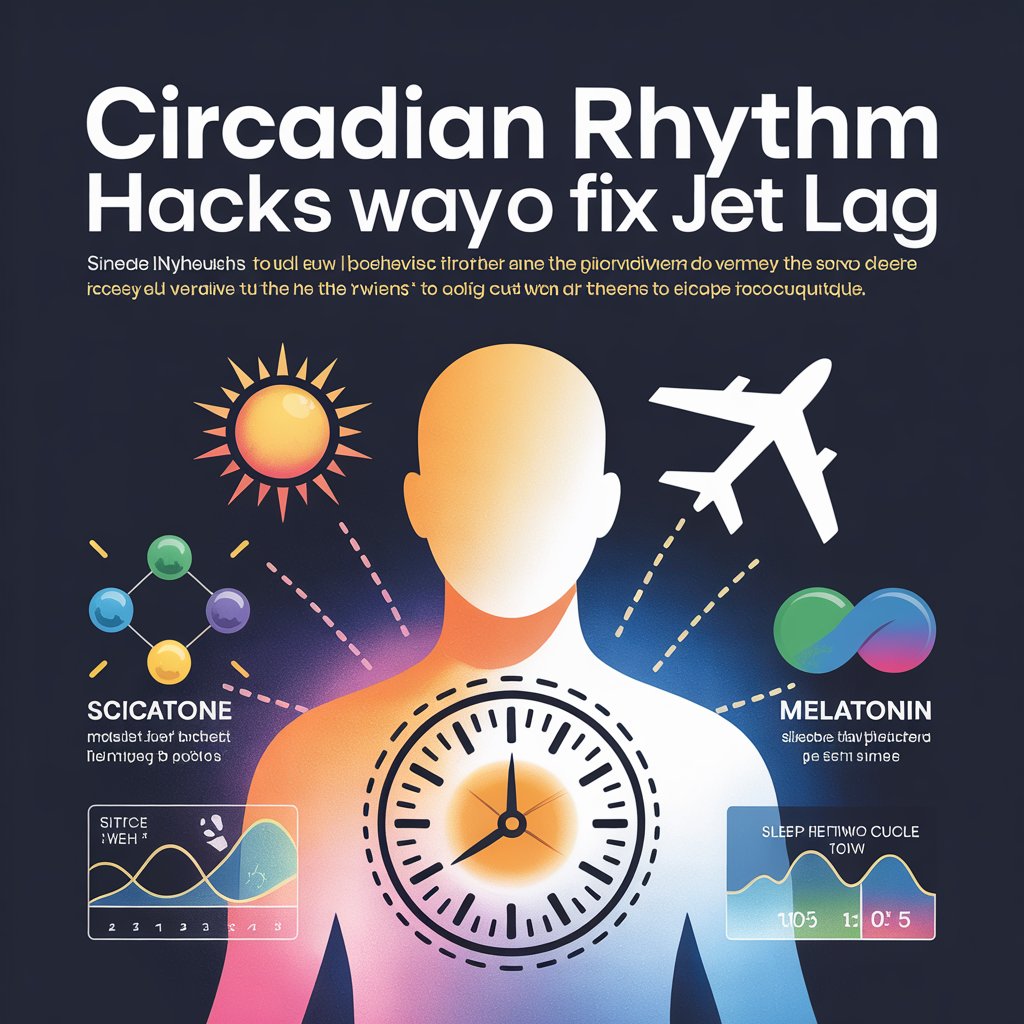
Your circadian rhythm is your body’s built-in 24-hour clock, governed primarily by a tiny region of the brain called the suprachiasmatic nucleus (SCN), located in the hypothalamus. This master clock orchestrates virtually every biological process in your body — from hormone release and body temperature to hunger, metabolism, and of course your sleep-wake cycle.
The SCN takes its most powerful cues from light. When light — especially blue-wavelength light — hits your retina in the morning, it signals the SCN to suppress melatonin (your sleep hormone), raise cortisol, and kickstart your alert, waking state. As daylight fades in the evening, the reverse happens: melatonin rises, body temperature drops, and your system prepares for sleep. This light-dark cycle is the primary timekeeper that keeps your circadian rhythm synchronized with the external world.
Your chronotype — whether you are naturally a morning person or a night owl — influences your personal rhythm, but everyone has one. And everyone’s rhythm can be disrupted when the external environment suddenly shifts out of sync with the internal clock. That is precisely what happens when you fly across multiple time zones.
Section 2: What Jet Lag Really Is — and Who Gets Hit Hardest
Jet lag occurs when your circadian rhythm is misaligned with the local time at your destination. Your body is still operating on home time while the sun, meals, and social cues around you are on a completely different schedule. This mismatch creates what chronobiologists call “circadian desynchrony.”
Common jet lag symptoms include:
- Difficulty falling asleep or staying asleep (insomnia after travel)
- Daytime fatigue and excessive sleepiness
- Impaired concentration and memory
- Irritability and low mood
- Digestive disruption — nausea, constipation, or appetite changes
- General travel fatigue and malaise
The direction of travel matters enormously. Flying eastward — say, from Los Angeles to New York, or from Chicago to Europe — is consistently harder than flying west. When you fly east, you are being asked to advance your clock (sleep and wake earlier), which goes against the body’s natural tendency to drift toward a slightly longer-than-24-hour day. Westward travel asks you to delay your clock, which is more forgiving. As a rule of thumb, it takes roughly one day per time zone crossed to fully recover — meaning a flight from New York to Tokyo (14 hours ahead) could mean nearly two weeks of disrupted sleep without intervention.
Who gets hit hardest? Frequent flyers who don’t allow adequate recovery time between trips, older adults (whose circadian systems are less flexible), travelers crossing more than five time zones, and anyone who already struggles with sleep deprivation before their flight. Shift workers, remote workers juggling international client calls at odd hours, and anyone with pre-existing sleep disorders are also especially vulnerable.
Section 3: Science-Based Hacks to Reduce Jet Lag Before You Fly
The single most underused jet lag strategy is pre-flight preparation. Most travelers do nothing to prep their circadian rhythm before departure and then wonder why recovery takes so long. A few days of intentional adjustment can make a measurable difference.
Shift Your Sleep Schedule Early
Two to three days before an eastward flight, start going to bed and waking up one hour earlier each day. For westward travel, push your bedtime and wake time one hour later each day. This gradual shifting begins the time zone adjustment process before you even board the plane, so your body is already partially aligned with your destination’s clock.
Use Light Strategically
Light exposure is the most powerful external cue for resetting your circadian rhythm. Before an eastward trip, seek out morning sunlight as early as possible and avoid bright light in the evening. Before a westward trip, do the opposite — get evening light exposure and delay your morning light.
Apps like Timeshifter (developed with input from leading circadian rhythm researchers) can generate a personalized light and dark schedule based on your specific flight itinerary and chronotype.
Time Your Melatonin Use
Low-dose melatonin supplements — typically 0.5 mg to 3 mg — can help shift your circadian rhythm when taken at strategic times. For eastward travel, take melatonin in the early evening a couple of days before your flight to advance your sleep timing. For westward travel, melatonin is less critical pre-flight but can be useful post-arrival. Research consistently shows that lower doses (0.5–1 mg) are often as effective as higher doses, with fewer side effects like morning grogginess.
Prioritize Sleep Before You Leave
Arriving at the airport already in sleep debt makes jet lag dramatically worse. Sleep deprivation impairs your brain’s ability to adapt to new time cues and reduces sleep quality upon arrival. Protect your sleep in the days before your flight as if it were a non-negotiable travel document.
Adjust Meal Timing
Research on the food-entrainable oscillator — a secondary biological clock in your liver and digestive system — suggests that when you eat can shift your body clock independently of light. Before an eastward trip, try eating your main meals slightly earlier. This primes your peripheral clocks for the new time zone.
Section 4: In-Flight Strategies to Minimize Circadian Disruption
What you do during the flight is just as important as what you do before it. A long-haul flight spanning multiple time zones is an opportunity to actively nudge your body clock in the right direction — or inadvertently anchor it further to home time.
Reset Your Watch Immediately
The moment you board the plane, set your watch (and your mindset) to destination time. This is not just symbolic — it helps you make better decisions about when to sleep, eat, and seek light during the flight, all of which matter.
Sleep on the Plane — But Time It Right
On a long-haul flight arriving in the morning at your destination, try to sleep as much as possible during the flight. On a flight arriving in the evening, resist the urge to sleep for the entire journey. Instead, time your sleep to overlap with nighttime at your destination. Use an eye mask, earplugs or noise-canceling headphones, and a neck pillow to create the best possible conditions for recovery sleep in a difficult environment.
A small dose of melatonin (0.5–1 mg) taken at the target destination’s bedtime can help trigger drowsiness on the plane when your body is not naturally ready for sleep.
Manage Blue Light Aggressively
Inflight entertainment screens, laptops, and phones emit blue light that suppresses melatonin and signals wakefulness to your SCN. If you are trying to sleep, avoid screens for at least 60 to 90 minutes beforehand. Most devices have a night-shift or warm-display mode that reduces blue-light output — use it when evening use of a screen is unavoidable.
Stay Hydrated
Airplane cabins typically maintain humidity levels between 10% and 20% — far drier than most indoor environments on the ground. Dehydration compounds travel fatigue, worsens cognitive performance, and exacerbates jet lag symptoms. Aim for at least 8 ounces of water per hour of flight, avoid excess alcohol (which disrupts sleep architecture), and limit caffeine to the earlier portion of the flight.
Eat Smart
Skip heavy, processed inflight meals if they fall at a time that does not align with eating hours at your destination. Overeating at the wrong time further anchors your peripheral clocks to home time. If your destination is still in the middle of the night, eating a large meal on the plane can confuse your body’s metabolic rhythms.
Section 5: Post-Flight Recovery Tips to Reset Your Internal Clock
You have landed. Now comes the most critical window — the first 48 hours at your destination — where your choices will either accelerate your body clock reset or delay it.
Get Outdoor Light at the Right Time
This is the single most powerful tool available after arrival. Morning sunlight exposure — getting outside within the first hour after waking, ideally for 20 to 30 minutes — sends a strong “it is morning here” signal directly to your SCN and begins synchronizing your circadian rhythm to local time. After flying east, bright outdoor light in the morning is your greatest ally. After flying west, evening light helps delay your clock into the new schedule.
Avoid sunglasses during these deliberate light-exposure walks, as the light needs to reach your retinal photoreceptors at full intensity.
Anchor Your Sleep Schedule
Even if you feel exhausted at 4 p.m. local time, resist falling asleep until within an hour or two of your target bedtime. Staying awake until a reasonable local bedtime on the first night — around 10 or 11 p.m. — is one of the fastest ways to anchor your sleep schedule to the new time zone. Yes, it is uncomfortable. But it is far more effective than giving in and waking at 3 a.m. wondering why you cannot get back to sleep.
Use Melatonin to Bridge the Gap
Taking 0.5 to 1 mg of melatonin about 30 minutes before your target local bedtime for the first three to five nights post-arrival can significantly accelerate circadian alignment. This is especially helpful for eastward travel, where falling asleep at 10 p.m. local time can feel impossible when your body still thinks it is 5 p.m.
Nap Strategically — Not Freely
Short naps of 20 to 30 minutes can restore alertness and cognitive performance without significantly disrupting nighttime sleep. The key is timing: schedule naps before 3 p.m. local time, and keep them short. Longer naps (90 minutes or more) or naps taken late in the afternoon can interfere with your ability to fall asleep at night and slow your circadian adjustment considerably.
Eat on Local Time From Day One
Aligning meal timing with your destination’s schedule — breakfast in the morning, dinner in the evening — helps synchronize your peripheral clocks (liver, gut, muscles) with local time. Skipping or delaying meals because you are not hungry can undermine this process. Eat light, nutritious meals on the local schedule even if your appetite is off.
Exercise at the Right Time
Moderate exercise can help advance or delay your circadian rhythm depending on when it is performed. Morning exercise after an eastward flight helps advance your clock; late afternoon or early evening exercise is more helpful after westward travel. Avoid vigorous exercise within three hours of bedtime, as it raises core body temperature and can make falling asleep harder.
Section 6: Mistakes That Make Jet Lag Worse
Even well-intentioned travelers regularly make choices that extend their jet lag. Here are the most common pitfalls to avoid.
Staying on home time. Calling home at your normal time, eating meals on home-time meals, and watching home-country TV at home-country hours all anchor your circadian rhythm to the wrong time zone. Commit to destination time as fully and immediately as possible.
Drinking too much alcohol. A glass of wine to help you sleep on the plane sounds logical but backfires. Alcohol suppresses REM sleep, fragments sleep architecture, and dehydrates you — all of which worsen jet lag symptoms the following day.
Loading up on caffeine to push through. Caffeine does not fix the underlying circadian misalignment — it just masks it while delaying your ability to fall asleep at the right time. Limit caffeine after noon local time, especially in the first few days.
Pulling all-nighters before the flight. The idea of staying up all night to “match” destination time might seem clever, but it sends you onto a long-haul flight in a state of acute sleep deprivation, which makes everything worse.
Relying on long naps. Sleeping for two or three hours in the afternoon at your destination might feel good in the moment, but it steals the sleep pressure you need to fall asleep at the right local time that night, pushing recovery back by another day.
Ignoring hydration. Chronic mild dehydration during and after a long-haul flight contributes directly to cognitive impairment, headaches, and fatigue — all of which are easily mistaken for jet lag.
Conclusion: Your Jet Lag Recovery Game Plan
Jet lag is a biological reality — but it is not something you simply have to endure. Your circadian rhythm is a responsive, adaptable system, and the science of sleep medicine has given us a remarkably clear picture of how to work with it rather than against it.
Here is a quick, practical recovery plan you can apply on your next trip:
2–3 Days Before:
- Gradually shift sleep and wake times toward your destination’s schedule
- Adjust light exposure timing to pre-shift your body clock
- Consider low-dose melatonin in the evening (eastward) or morning (westward)
On the Plane:
- Set your watch to destination time immediately
- Sleep and eat aligned with destination nighttime and meal hours
- Stay hydrated; avoid alcohol and limit caffeine
- Block blue light before sleep periods
After Arrival:
- Get 20–30 minutes of morning outdoor sunlight (eastward) or evening light (westward)
- Stay awake until a reasonable local bedtime on the first night
- Take 0.5–1 mg melatonin 30 minutes before target local bedtime for 3–5 nights
- Eat meals on local time from day one
- Nap only before 3 p.m. and for no longer than 30 minutes
For most travelers crossing up to eight time zones, applying these strategies consistently will cut jet lag recovery time roughly in half. That means more productive meetings, more energized mornings, and more of your trip spent feeling like you — rather than like a foggy, disoriented version of yourself running on the wrong time zone.
Your internal body clock is more responsive than you think. Treat it with intention, and it will reward you.
Always consult your physician before beginning any new supplement regimen, including melatonin, especially if you have existing health conditions or take other medications.