When Your Phone Is Winning the Bedtime Battle
It’s 11:47 PM. You told yourself you’d be asleep by 10. Instead, you’re three episodes deep into a show, your phone is glowing beside you, and your brain feels wired in a way that has nothing to do with caffeine. Sound familiar?
If you’re a student pulling late-night study sessions, a remote worker glued to screens all day, a gamer who can’t put the controller down, or simply someone whose phone has become a permanent fixture in bed — you’re part of a very large club. According to the American Academy of Sleep Medicine, over 90% of Americans use at least one electronic device in the hour before bed. And a significant chunk of them are paying for it in lost sleep.
Here’s the uncomfortable truth: your screens are quite literally messing with your biology. The blue light they emit suppresses melatonin — the hormone that tells your body it’s time to sleep — and throws off your circadian rhythm in ways that can take days to correct. The result? Trouble falling asleep, poor sleep quality, and that groggy, foggy feeling the next morning that no amount of coffee can fully fix.
The good news is that you don’t have to throw your devices out the window. What you do need is a smarter approach. This article breaks down 8 research-proven sleep hacks designed for real people who use real screens — and who still want real sleep.
Why Blue Light Affects Sleep: The Science in Plain English
Your body runs on a roughly 24-hour internal clock called the circadian rhythm. This clock is largely driven by light. When your eyes detect bright, blue-wavelength light — the kind abundant in morning sunlight — your brain interprets that as a signal to stay awake and alert. When darkness falls, your brain’s pineal gland begins releasing melatonin, signaling that it’s time to wind down and sleep.
The problem? The screens you stare at all day — your phone, laptop, TV, and tablet — all emit blue light wavelengths virtually identical to daylight. When you use them in the evening, your brain gets confused. It sees the light and thinks: it’s still daytime, hold the melatonin.
A landmark study published in the Proceedings of the National Academy of Sciences found that people who read on light-emitting devices before bed took longer to fall asleep, experienced less REM sleep, felt less alert the next morning, and had measurably lower melatonin levels compared to those who read printed books.
Digital eye strain is a related issue — the headaches, dry eyes, and visual fatigue that come from prolonged screen exposure — but the sleep disruption goes deeper. It’s hormonal, neurological, and cumulative. The more consistently you expose yourself to screens late at night, the more entrenched the pattern becomes.
Now let’s fix it.
8 Research-Proven Sleep Hacks for Screen Addicts
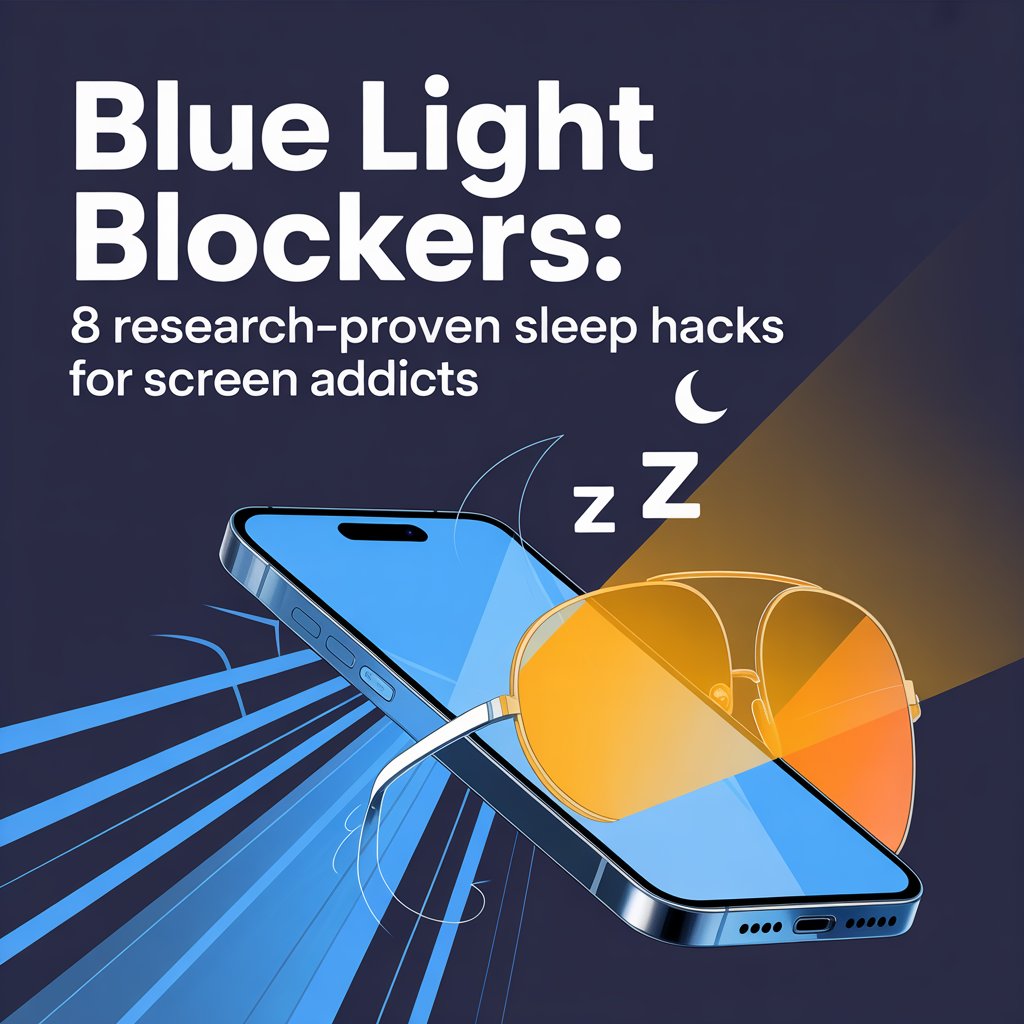
Hack #1: Use Blue Light Blocker Glasses in the Evening
Blue light blocker glasses — lenses tinted amber or yellow to filter out blue-wavelength light — are one of the most practical and well-studied tools for nighttime screen users.
A 2021 study published in the Journal of Applied Psychology found that employees who wore blue light blocking glasses before bed reported better sleep quality, improved task performance the next day, and felt more engaged at work. Another study in Chronobiology International showed that wearing amber-tinted glasses for two hours before sleep significantly increased melatonin levels and improved sleep duration.
How to use them: Put your blue light blocker glasses on about 2–3 hours before your target bedtime. You don’t have to stop using your screens — just filter what reaches your eyes.
Common mistake: Buying cheap, clear “blue light glasses” with minimal filtration. Look for lenses with at least 90% blue light blocking capability (typically amber or orange-tinted, not clear) for meaningful results.
Hack #2: Enable Night Mode — But Do It Right
Nearly every device now has a built-in night mode or “warm display” setting (Night Shift on iPhone/Mac, Night Light on Android/Windows). These features shift your screen’s color temperature from cool blue tones to warmer yellow or orange hues.
Research from Harvard Medical School confirms that warmer light wavelengths have significantly less impact on melatonin suppression than blue wavelengths. Night mode isn’t a perfect fix, but it meaningfully reduces your blue light exposure during evening screen time.
How to use it correctly:
- Set it to activate automatically at sunset (or 2–3 hours before bed)
- Crank the warmth level to maximum — most people leave it at default, which isn’t warm enough
- Lower your screen brightness alongside the color shift
Common mistake: Enabling night mode but keeping brightness at full blast. Brightness matters as much as color temperature. A dim, warm screen is far better for melatonin and blue light management than a bright warm one.
Hack #3: Start a Hard Stop 60 Minutes Before Bed
This one sounds obvious. It also works better than almost anything else.
A systematic review in Sleep Medicine Reviews found that screen-free time in the 30–60 minutes before bed was consistently associated with faster sleep onset, improved sleep quality, and better mood the next day. The brain needs a decompression window — a transition period between the stimulation of screens and the stillness of sleep.
Real-life scenario: Maria is a 32-year-old remote worker who used to scroll Instagram in bed until midnight. She started placing her phone on her nightstand charger at 10:30 PM and replaced that time with reading a paperback. Within two weeks, she was falling asleep in under 15 minutes instead of 45.
How to make it stick:
- Use a physical alarm or app reminder to signal your screen cut-off time
- Have a non-screen activity ready to replace scrolling (book, journal, light stretching)
- Charge your phone outside the bedroom if willpower is the weak link
Hack #4: Redesign Your Bedroom Lighting
Most people don’t realize that the overhead lights in their home are also contributing to sleep disruption long before they ever pick up a device. Bright white or cool-toned LED bulbs emit blue light just like screens do.
Research published in the Journal of Clinical Endocrinology & Metabolism found that exposure to overhead electric light before bedtime suppressed melatonin by over 50% in some participants, even without any screen use.
Sleep environment upgrades that work:
- Switch bedroom bulbs to warm-toned LEDs (2700K or lower color temperature)
- Use lamps instead of overhead lights after 8 PM
- Install blackout curtains to block streetlights and early morning sun
- Consider a red-light nightlight — red wavelengths have the least impact on melatonin
This is one of the most underrated sleep hacks in the toolkit, and it requires zero willpower to maintain once the bulbs are swapped.
Hack #5: Build an Evening Routine That Actually Works
A consistent evening routine doesn’t need to be a 14-step wellness ritual. It just needs to signal your nervous system that sleep is coming.
Research in Sleep Health journal shows that consistent pre-sleep routines — even simple ones — are strongly associated with improved sleep quality and reduced insomnia symptoms. The key mechanism is behavioral conditioning: your brain starts associating specific cues with sleep, making the transition faster and easier over time.
A practical 30-minute wind-down routine:
- 9:30 PM — Screens to night mode, brightness down
- 10:00 PM — Screens off; swap for a book, podcast (audio only), or light stretching
- 10:20 PM — Dim the lights, take a warm shower or wash your face
- 10:30 PM — In bed, no phone
Common mistake: Trying to build a complicated routine and abandoning it after three days. Start with one anchor habit and build from there.
Hack #6: Use Sleep and Relaxation Apps — Strategically
This might seem counterintuitive in an article about reducing screen time, but audio-based sleep apps used correctly can actually support better sleep hygiene.
Apps like Calm, Headspace, and Insight Timer offer guided meditations, sleep stories, and white noise tracks. Research published in JAMA Internal Medicine found that mindfulness meditation significantly improved insomnia and sleep quality in middle-aged adults. A separate study found that white noise improved sleep onset and reduced nighttime waking.
The rule: Audio only, screen face-down or off, brightness at zero. You get the benefit of the content without the blue light hit.
What to avoid: Using YouTube, TikTok, or social media as “relaxation” before bed. Passive scrolling keeps your brain alert and emotionally activated — the opposite of what you need.
Hack #7: Time Your Caffeine Like It Matters (Because It Does)
Blue light isn’t the only thing keeping screen addicts awake — caffeine timing is a massive, underappreciated factor in sleep quality.
Caffeine has a half-life of roughly 5–7 hours, meaning that a 3 PM coffee still has half its stimulating power in your bloodstream at 9 PM. A study in the Journal of Clinical Sleep Medicine found that caffeine consumed even six hours before bedtime significantly reduced sleep time.
Practical guidance:
- Set a caffeine cutoff of 1–2 PM for most people
- If you’re sensitive to caffeine, push that to noon
- Watch hidden caffeine sources: energy drinks, pre-workout supplements, some teas, and chocolate
Pairing late caffeine with late screen time is one of the most common mistakes people make — and fixing both together produces dramatically faster results than addressing either one alone.
Hack #8: Manage Your Sleep Environment Like a Pro
Beyond lighting, several physical factors in your sleep environment directly impact how quickly you fall asleep and how restorative that sleep is.
Temperature: Core body temperature naturally drops as you fall asleep. Research from the National Sleep Foundation recommends a bedroom temperature of 65–68°F (18–20°C) as optimal for most adults. Sleeping hot is one of the most common — and most fixable — causes of frequent waking.
Sound: Even low-level noise disrupts sleep architecture. A white noise machine or fan can mask ambient sounds and reduce the number of times your brain partially wakes to process noise.
The phone in the bedroom: Multiple studies have found that simply having a smartphone in the bedroom — even face-down and silent — is associated with lighter, more fragmented sleep. The psychological availability of the device keeps the brain in a mild state of alertness. Charge it outside the bedroom and use a cheap alarm clock instead.
Your Practical Bedtime Checklist
Use this checklist every night to build your better sleep naturally routine:
- [ ] Blue light blocker glasses on 2–3 hours before bed
- [ ] Night mode activated and brightness reduced by 8 PM
- [ ] No new screens (phone, laptop, TV) 60 minutes before sleep
- [ ] Bedroom lights switched to warm/dim settings
- [ ] Room temperature set to 65–68°F
- [ ] Last caffeine consumed before 2 PM
- [ ] Phone charging outside the bedroom
- [ ] Wind-down activity in place (book, audio, stretching)
Final Takeaway
Insomnia from screen time is a modern problem, but it’s also a solvable one. The research is clear: blue light, screen stimulation, and poor sleep habits are genuinely disrupting your sleep quality — but you don’t have to choose between your devices and your rest.
The most effective approach combines multiple small changes: blue light blocker glasses, warmer evening lighting, a consistent wind-down routine, strategic screen cutoff times, and a sleep environment designed for actual sleep. No single hack is magic. Together, they’re powerful.
Start with the one or two changes that feel most doable tonight. Build from there. Your brain, your mood, and your morning self will thank you.
FAQ
Do blue light blocker glasses really work? Yes, when they provide meaningful filtration (amber or orange lenses with 90%+ blue light blocking). Clear “blue light glasses” with minimal filtration have limited evidence behind them.
How long before bed should I stop using screens? Research supports a minimum of 30 minutes; 60 minutes is more effective. For people with chronic sleep problems, 90 minutes to 2 hours is worth trying.
Is night mode on my phone enough on its own? Night mode helps, but it’s not sufficient on its own — especially at high brightness. Combine it with reduced brightness, blue light glasses, and a screen cutoff time for best results.
Can I fix my circadian rhythm after years of bad sleep habits? Yes, but it takes consistency. Most people notice meaningful improvement in 1–2 weeks of good sleep hygiene. Full circadian rhythm reset can take 3–4 weeks.
What’s the single most impactful change I can make tonight? Move your phone out of the bedroom. It removes the temptation, reduces psychological alertness, and eliminates the urge to check it in the middle of the night — all in one step.
This article is for informational purposes only and does not constitute medical advice. If you have persistent sleep difficulties, consult a healthcare provider or sleep specialist.