You climb into bed around 10:30, phone in hand. “Just checking one thing,” you tell yourself. You glance at a text, then Instagram loads, then a news headline catches your eye, then you’re three threads deep in a Reddit rabbit hole about someone’s kitchen renovation. You blink. The clock reads 12:47 a.m. Your eyes burn. Tomorrow’s 6 a.m. alarm feels like a personal attack.
Sound familiar? You’re not alone. According to the CDC, roughly 1 in 3 American adults don’t get the recommended seven or more hours of sleep per night—and late-night screen time is one of the biggest contributors. The blue light, the mental stimulation, the endless dopamine drip of social media feeds: they all conspire against your ability to fall asleep and stay asleep.
But here’s the good news. You don’t need a monastery retreat or a week-long digital detox to fix this. What you need is a no-screen bedtime hack—a simple, repeatable evening routine that helps you unplug, calm your nervous system, and actually recharge overnight.
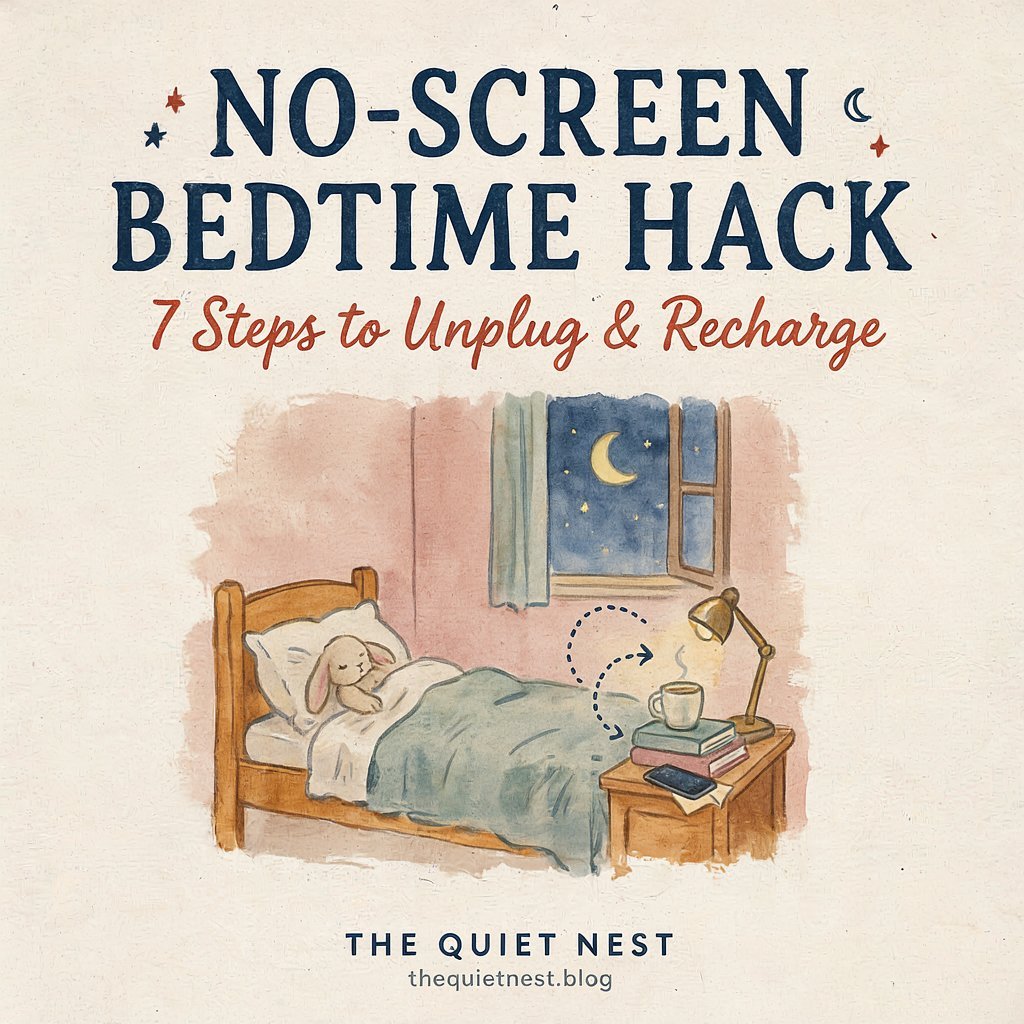
Below are 7 practical steps you can start tonight. No guilt. No perfection required. Just small shifts that add up to significantly better rest.
Why Screens Keep You Awake: The Science in Plain English
Before diving into the steps, it helps to understand why that glowing rectangle is so hard to put down—and so bad for sleep.
Blue light suppresses melatonin. Your brain produces melatonin, the hormone that signals “it’s time to sleep,” in response to darkness. The short-wavelength blue light emitted by phones, tablets, and laptops tricks your suprachiasmatic nucleus (your internal clock) into thinking it’s still daytime. Studies referenced by the American Academy of Sleep Medicine show that even 30 minutes of screen exposure before bed can delay melatonin release and push your sleep onset later.
Scrolling triggers mental arousal. Reading a tense work email, seeing a polarizing headline, or comparing your life to a curated vacation reel activates your sympathetic nervous system—the “fight or flight” branch. Your heart rate ticks up. Cortisol nudges higher. Not exactly the biochemical environment for drowsiness.
Dopamine keeps you hooked. Every notification ping, every new post, every “pull-to-refresh” delivers a tiny dopamine hit. Over time, your brain builds a habit loop: bed + phone = stimulation reward. Breaking that loop takes intention, not willpower alone.
The average American adult now spends over seven hours per day looking at screens (per recent Common Sense Media and Nielsen reports). Carving out even 30–60 minutes at the end of the day can make a measurable difference in how quickly you fall asleep and how rested you feel by morning.
Step 1: Set a Digital Sunset Time
Think of a digital sunset as a firm, friendly cutoff—like a neighborhood streetlight flicking on to say, “The day is officially over.”
How it works:
- Pick a consistent time to power down all screens: phone, laptop, tablet, TV.
- Start with 60 minutes before your target bedtime. If that feels impossible, begin with 30. You can build up.
- Set a phone alarm labeled “Digital Sunset 🌅” so you’re not relying on willpower or memory.
- Use built-in Screen Time (iPhone) or Digital Wellbeing (Android) limits to gently nudge you when the cutoff arrives.
Handling the “just one more check” urge:
- Tell yourself, “It’ll still be there tomorrow.”
- Put your phone face-down or in another room the moment the alarm sounds.
- If FOMO spikes, remind yourself: you’re not missing anything urgent. Truly urgent matters will find you via a phone call.
Start tonight: Set your digital sunset alarm for 30 minutes before bed. When it rings, plug your phone in across the room and walk away. That’s it. One small win.
Step 2: Create a Tech-Free Bedroom Zone
Your bedroom should cue one thing in your brain: rest. When you scroll, stream, or answer emails in bed, you blur that signal. Over time, your brain starts associating the mattress with stimulation instead of sleep.
Practical moves:
- Charge your phone outside the bedroom (kitchen counter, hallway shelf, home office). If that feels extreme, charge it across the room so you’d have to physically get up to grab it.
- Swap your phone alarm for a traditional alarm clock. They cost $10–$20 and eliminate the “I need my phone to wake up” justification.
- Enable Do Not Disturb or Focus mode on any device that stays nearby, silencing all notifications except calls from designated emergency contacts.
“But what about emergencies?” This is the most common objection, and it’s valid. Here’s the fix: set your phone to allow calls only from your partner, kids, or a parent. Everything else—texts, emails, app pings—waits until morning. True emergencies are rare; doomscrolling at midnight is not an emergency response plan.
The payoff: A tech-free bedroom reinforces healthy sleep habits for adults by strengthening the mental link between your bed and restful sleep. This is a core principle of cognitive behavioral therapy for insomnia (CBT-I), the gold-standard treatment endorsed by the American Academy of Sleep Medicine.
Step 3: Replace Scrolling with a Calming Wind-Down Ritual
Here’s where most people stall. They remove the phone and then sit in silence, feeling bored and restless. The fix isn’t to white-knuckle the boredom—it’s to fill the gap with something genuinely soothing.
Pick 2–3 options and rotate them so the routine stays fresh:
- Read a physical book or magazine. Fiction works best; avoid “productivity” or self-help titles that get your planning brain revving.
- Journal or do a gratitude practice. Even three sentences count.
- Light stretching or restorative yoga. Child’s pose, legs-up-the-wall, or gentle neck rolls release physical tension.
- Take a warm shower or bath. The subsequent drop in body temperature mimics your natural pre-sleep cooldown.
- Listen to calming music, a sleep podcast, or ambient sounds—screen off, eyes closed.
These activities activate your parasympathetic nervous system (the “rest and digest” branch), signaling safety to your brain and lowering cortisol.
Build your own 15-minute wind-down routine:
- Minutes 1–5: Warm shower or gentle stretching
- Minutes 6–10: Read a few pages of a novel
- Minutes 11–15: Dim the lights, sip herbal tea, and settle into bed
Adjust the blocks to fit your life. The structure matters more than the specific activities.
Step 4: Dim the Lights and Lower Stimulation
Even after screens are off, your environment can still scream “daytime” to your circadian rhythm. Bright overhead lights, loud TV in the next room, and visual clutter all keep your brain on alert.
Simple adjustments:
- Switch to warm-toned bulbs (2700K or lower) in your bedroom and living areas during the evening.
- Use dimmable lamps or smart bulbs (like Philips Hue or LIFX) set on a gradual dimming schedule.
- Reduce noise: turn off the TV, lower music volume, or use a white-noise machine to mask household sounds.
- Tidy quick: spend two minutes clearing visible clutter off your nightstand and dresser. Visual chaos = mental chaos.
This step supports your body’s natural melatonin curve and makes the transition from “doing” to “resting” feel gradual rather than abrupt. Think of it as dimming the lights on a theater stage before the curtain falls.
Step 5: Practice a 5-Minute Mindfulness or Breathing Exercise
If racing thoughts are your main sleep thief, a short breathing practice can be a game-changer. You don’t need an app (though one is fine if it’s already loaded and your screen stays off). Try this:
The 4-7-8 Breath (a favorite for how to unplug before sleep):
- Sit or lie comfortably. Close your eyes.
- Inhale quietly through your nose for a count of 4.
- Hold your breath for a count of 7.
- Exhale slowly through your mouth for a count of 8, making a soft “whoosh” sound.
- Repeat for 4 cycles (about one minute), then continue with natural breathing for another 3–4 minutes.
Why it works: Extended exhales stimulate the vagus nerve, activating your parasympathetic system and slowing your heart rate. It’s essentially a physiological “off switch” for the anxiety loop.
If breath-holding feels uncomfortable, try box breathing instead: inhale 4, hold 4, exhale 4, hold 4. Same calming effect, gentler rhythm.
Key takeaway: You don’t need to “empty your mind.” Just anchor attention to the breath. When thoughts wander, gently return. That is the practice.
Step 6: Write a “Brain Dump” or Tomorrow Plan
Ever lie awake mentally rehearsing tomorrow’s to-do list or replaying an awkward conversation from 2019? Unresolved thoughts are like browser tabs draining your battery overnight. A quick written brain dump closes those tabs.
The 5-minute nighttime journaling routine:
Grab a small notebook (keep it on your nightstand so you don’t need your phone) and jot down:
- 3 things you’re grateful for today. They can be tiny: good coffee, a text from a friend, sunlight on your walk.
- 1–3 priorities for tomorrow. Not a full to-do list—just the top items so your brain knows they’re handled.
- Any lingering worries. Write them down and literally tell yourself, “This is parked until morning.”
This practice is a form of cognitive offloading. A 2018 Baylor University study found that participants who spent five minutes writing a to-do list before bed fell asleep significantly faster than those who journaled about completed tasks. The act of externalizing the thought tells your brain, “You can stop rehearsing this now.”
Step 7: Commit to a Consistent Sleep Schedule
All the wind-down rituals in the world lose potency if your bedtime bounces between 10 p.m. on weekdays and 1 a.m. on Saturdays. Consistency is the backbone of any screen curfew for better rest.
How to lock it in:
- Choose a bedtime and wake time that allow 7–9 hours of sleep, then protect them seven days a week. Yes, weekends too (within a 30-minute window).
- If your current schedule is way off, shift gradually: move bedtime 15 minutes earlier every 2–3 nights until you hit your target.
- Pair your no-screen routine with the same bedtime nightly. Over 2–3 weeks, the habit loop solidifies: dim lights → wind-down → bed → sleep.
- Track your sleep for one to two weeks (a simple notebook works) to see patterns and celebrate progress.
The no-screen bedtime hack works best as part of a larger rhythm. Consistency tells your circadian clock exactly when to ramp down melatonin and when to ramp it back up. Give it two weeks, and falling asleep starts to feel automatic again.
Common Challenges & How to Overcome Them
Let’s be real: going screen-free at night isn’t always easy. Here are the hurdles readers mention most, plus workarounds.
“I work late and can’t avoid screens.”
Totally understandable. Aim for even 15 minutes of screen-free time before bed. Close the laptop, step away, and do a quick stretch or breathing exercise. You don’t need a full hour to see benefits. Over time, see if you can negotiate boundaries around after-hours email.
“My partner or kids still use devices at night.”
You can’t control their habits, but you can control your environment. Use earplugs or a white-noise machine, angle your reading lamp away from their screen glow, and kindly request headphones for videos. Compromise where you can; protect your wind-down space where you need to.
“I get bored without my phone.”
Boredom is often just unfamiliarity. The first two or three nights feel weird because your brain expects the dopamine hit. By night four or five, the ritual starts to feel comforting. Lean into the alternatives from Step 3. Give yourself permission to simply be still.
Progress over perfection. Miss a night? Fine. Pick the routine back up the next evening. One off-night doesn’t erase the habit you’re building.
What to Expect: Benefits of a No-Screen Bedtime Routine
Stick with these steps for even one to two weeks, and most people notice:
- Falling asleep faster (often within 15–20 minutes instead of 45+)
- Fewer nighttime awakenings and less difficulty drifting back off
- Waking up feeling more refreshed, less groggy
- Reduced evening anxiety and less pre-sleep rumination
- Better daytime mood, focus, and patience
You may also notice a pleasant side effect: reclaiming 30–60 minutes of evening time for hobbies, conversation, or simply quiet. A nighttime digital detox isn’t deprivation—it’s a trade-up.
Track it: Keep a simple sleep log for 14 nights. Note bedtime, wake time, and a 1–5 “rested” rating. Watching the trend line improve is powerful motivation.
Conclusion: Reclaim Your Rest, One Evening at a Time
Here’s your no-screen bedtime hack in one breath: Set a digital sunset. Make your bedroom tech-free. Swap scrolling for a calming wind-down ritual. Dim the lights. Breathe for five minutes. Brain-dump your thoughts on paper. Show up at the same bedtime every night.
Seven small steps. No apps to buy. No expensive gadgets. Just a gentle, repeatable evening digital curfew that tells your body, “The day is done. You’re safe. Rest now.”
In a hyperconnected world that profits from your attention at every hour, choosing to unplug and recharge at night is a quiet act of self-respect. You deserve sleep that actually restores you—not sleep you stumble into at 1 a.m. after a scrolling marathon you don’t remember starting.
Try it for seven nights. Start tonight. Set that digital sunset alarm, charge your phone across the room, and give yourself permission to do less before bed. Then notice how you feel on morning eight.
If this helped, share it with a friend who’s been doomscrolling into the wee hours. Drop a comment below and tell me which step you’re trying first—I’d love to hear how it goes. And if you want more sleep hygiene tips, bedtime routine ideas, and practical wellness guides, hit subscribe so you never miss a post.
You don’t have to earn rest. You just have to make space for it. Start tonight. 🌙