You know the drill. You finally crawl into bed, physically exhausted, ready to drift off after a long day. But the moment your head hits the pillow, your brain decides it’s prime time to replay every awkward conversation you’ve had since 2016, stress over tomorrow’s packed schedule, or urge you to pick up your phone for a late-night doomscrolling session.
Welcome to “stress o’clock,” an all-too-common nightly struggle for millions of Americans. In our fast-paced, always-on modern world, the bedroom has unfortunately become an extension of the office or a theater for bad news. We carry the weight of our overflowing inboxes, household responsibilities, and societal stressors right under the covers.
If racing thoughts and midnight tossing and turning are sabotaging your rest, you don’t necessarily need a complicated new sleep gadget or an expensive supplement. Sometimes, the most effective sleep hygiene tips are also the simplest. Enter the gratitude bedtime hack: a surprisingly powerful, low-cost shift in your evening self-care routine that can help quiet a chaotic mind, boost your mood, and support deeper rest.
In this guide, we’ll explore exactly how a bedtime gratitude practice works, what the research says about gratitude and sleep quality, and how you can easily integrate this positive bedtime routine into your life tonight.
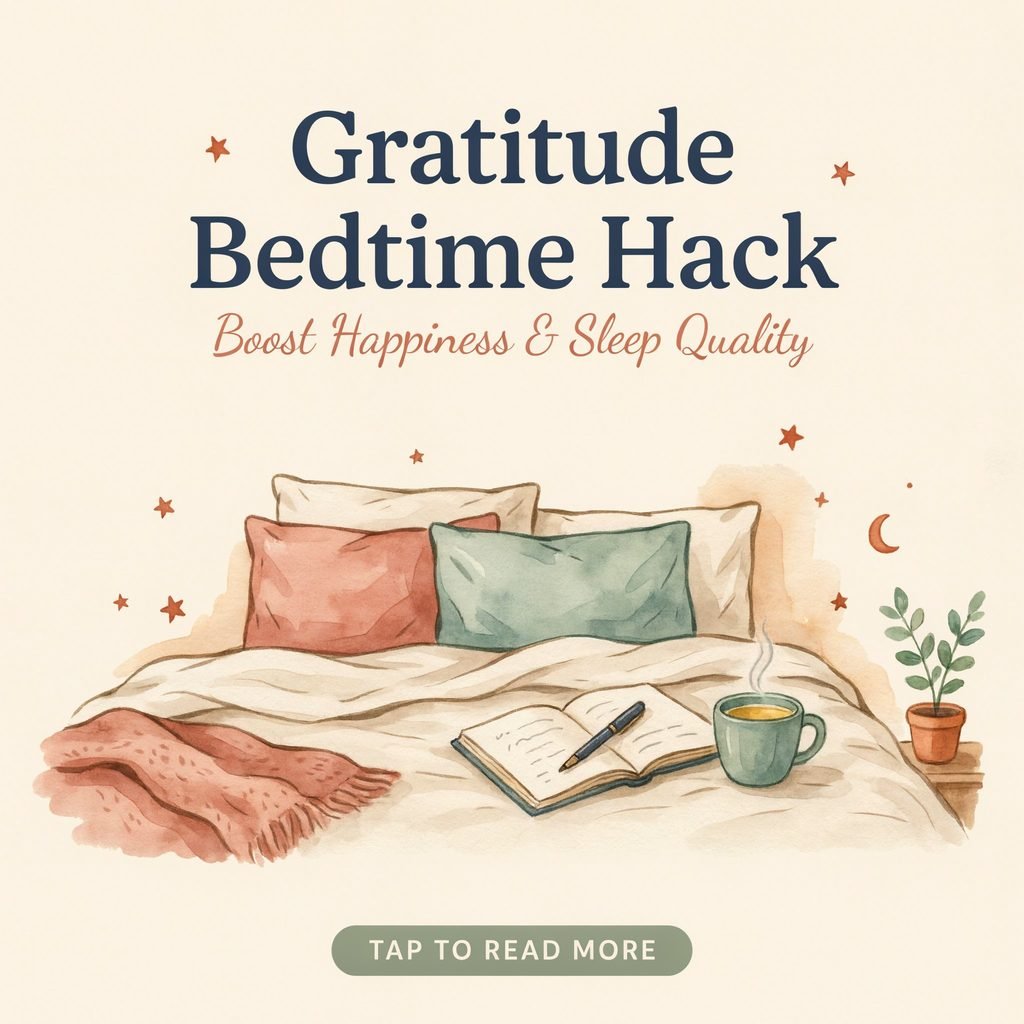
What Is the Gratitude Bedtime Hack?
At its core, the gratitude bedtime hack is the intentional practice of spending a few minutes right before sleep identifying and reflecting on specific things you appreciate from your day or your life in general. Rather than letting your mind wander into stressful territory, you actively redirect your focus toward the positive.
Think of it as a mental palate cleanser. It’s a form of mindfulness before sleep that acts as a bridge between the high-stimulation demands of your day and the restful state required for sleep. It doesn’t require hours of meditation or an expensive journal. It simply requires a few minutes of focused attention on the good things, big or small, that you often overlook.
Why Gratitude Before Bed Works: Happiness and Stress Relief
Why does focusing on the good actually help us wind down? The benefits of gratitude extend far beyond just feeling polite or thankful. Cultivating happiness habits through regular appreciation actually shifts your neurochemistry and emotional state.
- Emotional Closure: Your brain has a natural “negativity bias,” meaning it’s wired to remember threats and stressors more vividly than positive events. By consciously identifying good things, you create a sense of emotional closure for the day. You signal to your brain that you are safe and supported.
- Stress Relief Before Bed: Reflecting on positive experiences can lower cortisol levels and calm your nervous system. It acts as an effective stress relief before bed, shifting your body out of a “fight-or-flight” state and into a “rest-and-digest” mode.
- Fostering Emotional Balance: Regular gratitude exercises for adults help build resilience. When you train your brain to look for the good, you create a more balanced emotional baseline, making it easier to handle daily frustrations without carrying them into your bedroom.
- Neurochemical Boosts: When you actively practice gratitude, your brain releases dopamine and serotonin—the neurotransmitters responsible for our “feel-good” emotions. These are the exact same chemicals that many antidepressants target. By naturally boosting these chemicals right before bed, you are essentially giving your nervous system a gentle, chemical hug.
Furthermore, gratitude acts as a powerful circuit breaker for anxiety. Anxiety lives in the future (worrying about what might happen), while regret lives in the past. Gratitude anchors you firmly in the present moment. By forcing your brain to scan your immediate environment or recent past for positive elements, you interrupt the neural pathways associated with chronic worry.
Gratitude and Sleep Quality: What the Science Suggests
You might wonder how simply thinking about good things translates to better physical rest. The connection between gratitude and sleep quality largely comes down to your pre-sleep cognitions.
When you lie in bed worrying, ruminating on an argument, or stressing over a deadline, your brain remains highly active. This cognitive arousal triggers the release of stress hormones like cortisol and adrenaline, which delay sleep onset and fragment your sleep cycles. Research published in behavioral science journals suggests that practicing gratitude journaling before bed can naturally interrupt this cycle of rumination.
Studies have shown that people who spend just 15 minutes a few nights a week counting their blessings before bed often report sleeping significantly longer and better. They wake up feeling more refreshed because they spent less time in a state of cognitive hyperarousal. By filling your mind with positive pre-sleep thoughts, you give your brain a neutral or uplifting focal point that lacks the emotional charge of a worry. While it’s important to remember that a gratitude practice is not a magic cure-all, learning how to sleep better naturally often starts with managing the mental chatter that keeps us awake.
The 5-Minute Gratitude Bedtime Routine
Ready to try it? Here is a simple, step-by-step method to build your own positive bedtime routine in just five minutes.
- Disconnect and Dim the Lights (1 Minute): Put your phone on a charger across the room. Blue light and social media are enemies of sleep. Dim your bedside lamp to signal to your body that it’s time to wind down.
- Ground Your Body (1 Minute): Sit comfortably on the edge of the bed or lie down. Take three slow, deep breaths. Inhale through your nose for a count of four, hold for two, and exhale through your mouth for a count of six.
- Identify 1 to 3 Things (1 Minute): Think back over your day or your life. Choose one to three specific things you genuinely appreciate. They don’t have to be massive life events; the smell of rain or a good cup of tea works perfectly.
- Elaborate on the “Why” (1 Minute): This is the most crucial step for mental wellness tips. Don’t just list an item; explain why you are grateful for it. For example: “I’m grateful for the ten quiet minutes I had with my coffee this morning because it helped me start the day calmly.” Adding the “because” deepens the emotional impact.
- Let It Sink In (1 Minute): Close your eyes and physically feel the warmth of that appreciation in your body. Let the positive sensation linger as you drift off to sleep.
15 Bedtime Gratitude Journal Prompts
If you prefer putting pen to paper, keeping a notebook by the bed is a fantastic idea. Here are 15 original gratitude journal prompts specifically designed for bedtime reflection:
- What was the best thing I ate or drank today, and why did I enjoy it?
- Who made my day a little easier today, and how can I acknowledge them tomorrow?
- What is one modern convenience I used today that I usually take for granted (like hot water or electricity)?
- What is a challenge I faced today that I am proud of navigating?
- What is one beautiful thing I saw today (a sunset, a flower, a piece of art)?
- What is a personal strength that helped me get through today?
- What is a comforting item in my bedroom that I am thankful for right now?
- Who is someone that made me smile recently, and why do I appreciate them?
- What is a piece of good news I heard or read about this week?
- What is a small, unexpected moment of kindness I witnessed or received today?
- What is a hobby or activity that brought me joy recently?
- What is a lesson I learned today that I am thankful for, even if it was hard?
- What part of my body functioned well today that I am grateful for?
- What is a fond memory that came to mind today that made me happy?
- What is something I am looking forward to tomorrow?
The 7-Day Gratitude Bedtime Challenge
Want to turn this into a lasting habit? Try this 7-day gratitude bedtime challenge. Spend two minutes each night reflecting on these specific themes:
- Night 1: People. Think of one person who supported you this week and why you value them.
- Night 2: Comforts. Focus on the physical comforts around you right now—your mattress, a warm blanket, the quiet room.
- Night 3: Nature. Recall a moment of natural beauty you experienced recently.
- Night 4: Growth. Identify a mistake you made or a challenge you faced, and be thankful for the lesson it taught you.
- Night 5: Senses. What was the best thing you smelled, heard, or tasted today?
- Night 6: Health. Focus on one specific thing your body allowed you to do today.
- Night 7: The Future. Think of one specific thing you are genuinely excited about for the week ahead.
How to Make It a Habit: Tips for Success
Like any new happiness habits, consistency is key. Here are practical ways to ensure your nighttime routine for better sleep actually sticks:
- Habit Stacking: In his book Atomic Habits, author James Clear popularized the concept of “habit stacking”—the idea that you are much more likely to stick to a new behavior if you anchor it to an existing one. The formula is simple: “After I [CURRENT HABIT], I will [NEW HABIT].” For example, do it immediately after brushing your teeth.
- Keep a Notebook by the Bed: If you like journaling, keep a dedicated notebook and a nice pen on your nightstand. Make it inviting and distinct from your work journals.
- Set a “Wind-Down” Reminder: Use a phone alarm to remind you to start your routine, but immediately put the phone on Do Not Disturb or across the room once the alarm goes off.
- Pair with Deep Breathing: Combine your mental reflection with physical relaxation techniques to enhance the sleep hygiene benefits.
- Avoid Screens: Doomscrolling is the ultimate mood killer. Keep your bedroom a phone-free zone to protect your mental wellness.
Gratitude Practice Variations
Not everyone loves writing in a journal, and that’s completely okay. Here is how to adapt the gratitude bedtime hack for different lifestyles:
- For the Busy Professional: Mental reflection works just as well as writing. As you lie in bed, simply name your three things in your head, focusing deeply on the feeling of appreciation.
- For Parents: Share the practice with your kids. Ask them, “What was your favorite part of today?” while tucking them in. It models good emotional habits for them and helps you wind down together.
- For the Tech-Savvy (but tired): Use voice memos. Record a quick 30-second audio diary on your phone of what you’re thankful for, then immediately lock the phone.
- For Students: Focus on academic wins or moments of friendship. Even if it was just finally understanding a difficult concept, acknowledge that progress.
- For Partners: Share your daily gratitudes with each other in the dark before falling asleep. It fosters intimacy and ends the day on a deeply positive note.
Common Mistakes to Avoid
To get the most out of this positive bedtime routine, watch out for these common pitfalls:
- Forcing Positivity: Gratitude is not about toxic positivity. You don’t have to be thankful for bad things happening to you. Instead, look for small lights in the dark. It’s okay to say, “Today was really hard, but I’m grateful I got through it.”
- Repeating Generic Entries: Simply writing “I’m grateful for my family” every night eventually loses its emotional punch. Get specific. Instead of “my dog,” write “how my dog wagged her tail when I walked in the door.”
- Using It to Ignore Problems: Gratitude should not be a band-aid for unresolved issues. It’s a tool for emotional regulation, not a way to suppress valid feelings of anger or sadness.
- Turning It into a Chore: If you feel stressed about doing your gratitude journal, you’re missing the point. Keep it light, flexible, and pressure-free.
When Gratitude Is Not Enough
While the gratitude bedtime hack is a fantastic tool for mental wellness tips and everyday stress relief, it is not a replacement for professional medical or psychological care.
If you are dealing with chronic insomnia, persistent anxiety, clinical depression, or sleep disorders that do not improve with basic sleep hygiene tips, please reach out to a healthcare provider or a licensed therapist. Gratitude can be a wonderful complementary practice alongside therapy or medical treatment, but it should never replace professional help when you are truly struggling.
Frequently Asked Questions
Is it better to write gratitude in the morning or at night?
Both times have benefits! Morning gratitude can set a positive tone for the day and boost your mood, while a gratitude bedtime hack specifically helps calm the nervous system, process the day’s events, and prepare your brain for sleep. Choose the time that best fits your lifestyle and goals.
How many things should I list before bed?
Most research on gratitude exercises for adults suggests that listing three things is the “sweet spot.” It’s enough to shift your mindset without turning the practice into a long, tedious homework assignment. However, even focusing deeply on just one specific thing can be highly effective.
Can gratitude really help me fall asleep?
While it is not a sleeping pill, gratitude can certainly create the optimal mental environment for sleep. By reducing negative pre-sleep cognitions—like worry and rumination—gratitude helps lower cognitive arousal, making it much easier to drift off naturally.
What if I had a terrible day?
This is when the practice is actually most important! On bad days, do not force yourself to be thankful for the terrible events. Instead, look for micro-moments. Are you grateful for the warm shower you are about to take? The softness of your pillow? The fact that the terrible day is finally over? Find the small anchors of comfort.
How long does it take to notice benefits?
Many people report feeling a sense of calm after just one night of the practice. However, to see significant changes in your overall baseline happiness and consistent improvements in gratitude and sleep quality, aim to practice it consistently for at least two to three weeks.
Can children use a bedtime gratitude practice?
Absolutely. It is a wonderful way to help kids process their emotions and end the day feeling secure. Keep it simple for kids. Ask them to name their “high” of the day, or what made them smile.
Conclusion: Your Path to Better Rest Starts Tonight
Your bedtime routine shouldn’t be a source of stress; it should be a sanctuary. By adopting the gratitude bedtime hack, you are giving yourself permission to close the laptop on the day’s worries and shift your focus to the good that surrounds you.
This simple bedtime gratitude practice is more than just a sleep strategy—it’s a daily investment in your emotional well-being, your happiness, and your peace of mind. You don’t need any special equipment or hours of free time. You just need five minutes and a willingness to look for the good.
Call to Action:
Ready to transform your nights? Take the 7-Day Gratitude Bedtime Challenge starting tonight. Grab a notebook, turn off your phone, and write down your first specific “because.” Pay attention to how you feel, how you sleep, and how you wake up. You might just find that counting your blessings is the best sleep remedy you’ve ever tried. Sweet dreams!