The alarm blares at 6:00 AM. You slap the snooze button, drag yourself out of bed, and stumble toward the kitchen. Your brain feels wrapped in cotton, your reaction time is sluggish, and you can barely string a coherent thought together. If you are a daily commuter, a parent managing a chaotic morning routine, or a shift worker transitioning off a night shift, you know this feeling all too well.
You aren’t just “tired.” You are experiencing sleep inertia—the physiological period of impaired alertness, decreased cognitive function, and intense morning grogginess that occurs immediately after waking. While it is a universal human experience, severe sleep inertia can derail your productivity and even compromise your safety.
The good news? You don’t just have to suffer through it. By looking at peer-reviewed sleep lab research, we can uncover the biological mechanisms behind waking up groggy and hack them. Below are five evidence-based, lab-backed strategies to help you beat sleep inertia, sharpen your mind, and reclaim your mornings.
Why Sleep Inertia Matters: The Science and the Risks
To understand how to wake up faster, we first need to understand what is happening inside your brain. When you sleep, your brain cycles through different stages, including light sleep, deep (slow-wave) sleep, and REM (dream) sleep. During deep sleep, your brain waves slow down dramatically to facilitate physical recovery and tissue repair.
When your alarm pulls you out of deep sleep, your brain’s prefrontal cortex—the area responsible for executive function, decision-making, and alertness—takes time to “boot up.” Blood flow to the brain is still reduced, and residual slow-wave brain activity bleeds into your waking state. This biological lag is the core driver of morning grogginess.
The Hidden Safety Risks
While feeling foggy is annoying, the risks of sleep inertia extend far beyond a ruined morning mood. According to sleep lab research, the cognitive impairment caused by severe sleep inertia can be comparable to mild alcohol intoxication.
- Sleep Inertia Safety for Drivers: The AAA Foundation for Traffic Safety has highlighted the dangers of driving immediately after waking. Reaction times are significantly blunted, making the morning commute a high-risk window for accidents.
- Workplace and Shift Worker Risks: For healthcare workers, first responders, and industrial shift workers, making a critical decision within 15 minutes of waking from a nap or a night shift can lead to dangerous medical or operational errors.
- Duration and Variability: For most, sleep inertia lasts between 15 and 30 minutes. However, for those who are chronically sleep-deprived, or those jolted awake from the deepest stages of slow-wave sleep, the fog can last up to two hours.
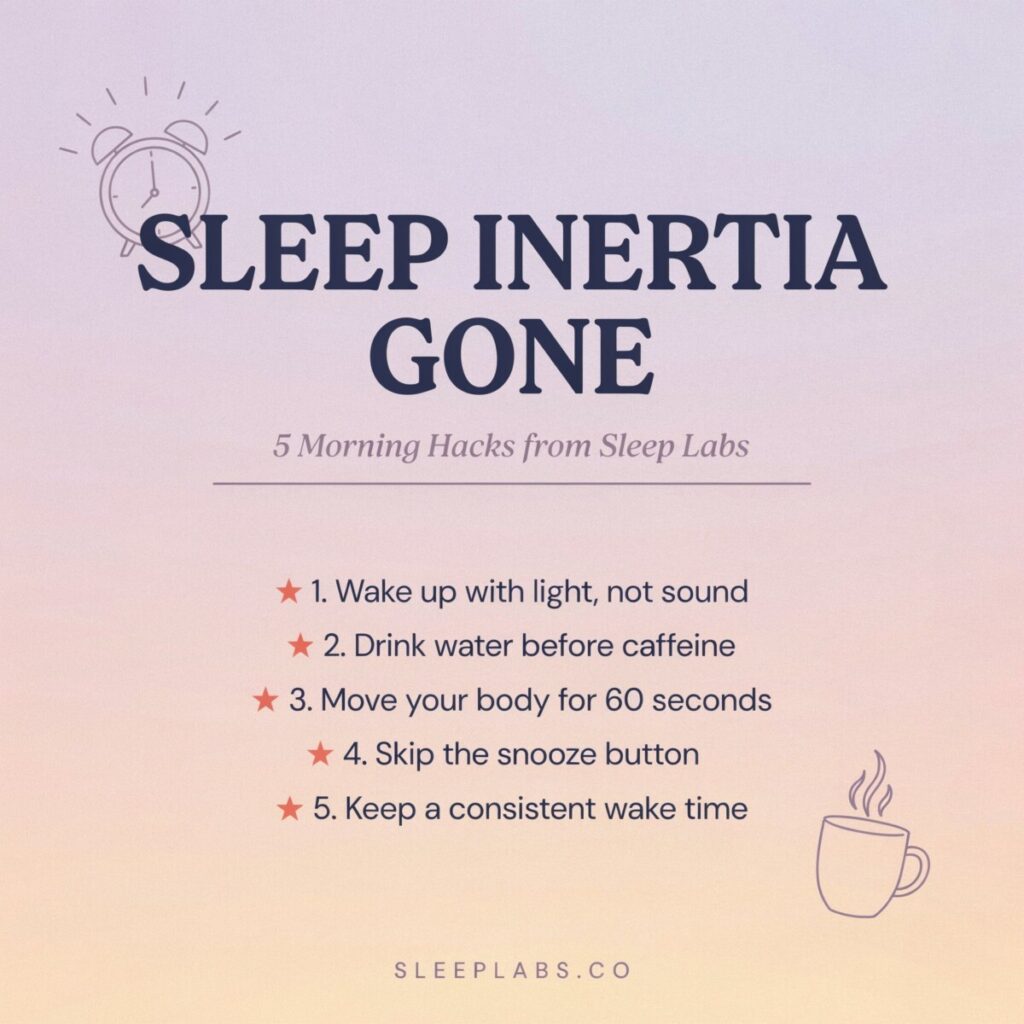
Fortunately, science offers actionable sleep inertia remedies. Here are five morning hacks derived directly from clinical sleep studies.
Hack 1: Strategic Wake Timing and Sleep Cycle Alignment
The Hack: Time your alarm to coincide with the end of a 90-minute sleep cycle, avoiding abrupt awakenings during deep slow-wave sleep.
The Science of Sleep Cycles
A typical adult sleep cycle lasts roughly 90 minutes, moving from light sleep into deep sleep, and finally into REM sleep. Sleep lab studies consistently show that waking up during light sleep or REM results in significantly fewer cognitive deficits and less morning grogginess than waking during deep sleep. When you interrupt deep sleep, you force the brain to shift from delta waves to beta waves too rapidly, triggering intense sleep inertia.
The Protocol: Alarm Strategies for Deep Sleepers
To leverage this, you need to align your wake time with your biological cycles.
- Use the 90-Minute Rule: If you need to wake up at 6:30 AM, count backward in 90-minute increments. Going to bed at 11:00 PM (allowing 15 minutes to fall asleep) gives you exactly five full cycles (7.5 hours of sleep).
- Invest in Smart Alarms: Consider wearable tech or smartphone apps that use actigraphy (movement tracking) to monitor your sleep stages. These devices utilize smart alarm strategies to gently wake you within a 30-minute window when you are in your lightest sleep phase.
- Plan Strategic Naps: If you nap during the day, keep it under 20–30 minutes. This ensures you get the restorative benefits of light sleep without entering deep sleep, thereby avoiding the dreaded “nap hangover.”
Micro-Case Study: David, an ER nurse working rotating shifts, used to set his alarm for a rigid 7 hours of sleep, often waking up mid-cycle and feeling nauseous with grogginess. By shifting his sleep window to 7.5 hours (five full cycles) and using a smart alarm, his self-reported morning alertness improved dramatically within a week.
Hack 2: Light Therapy for Waking and Circadian Reset
The Hack: Expose your eyes to bright, blue-enriched light within 10 minutes of waking to halt melatonin production and trigger a natural cortisol awakening response.
The Science of Light and the Master Clock
Your circadian rhythm—the internal 24-hour clock governing sleep and wakefulness—is primarily regulated by light. Specialized photoreceptors in your eyes called melanopsin ganglion cells detect light (especially blue wavelengths from the sun) and send a direct signal to the suprachiasmatic nucleus (SCN), the brain’s master clock.
Clinical studies demonstrate that bright light exposure immediately upon waking suppresses residual melatonin (the sleep hormone) and stimulates the release of cortisol and adrenaline. This acute alerting effect is one of the most reliable ways to beat sleep inertia and synchronize your circadian rhythm and waking patterns.
The Protocol: Getting Your Morning Lux
- The Gold Standard (Sunlight): Step outside for a brisk 5 to 15-minute walk within 20 minutes of waking. Even on a cloudy day, outdoor lux (light intensity) is vastly superior to indoor lighting.
- Light Therapy for Waking (Indoors): If you wake up before dawn, or live in a climate with dark winters, use a 10,000-lux light therapy box. Position it about 16–24 inches from your face at a slight angle while you eat breakfast or read. Aim for 20–30 minutes of exposure.
- Sunrise Alarm Clocks: These devices gradually illuminate your room over 30 minutes before your audio alarm sounds, gently pulling your brain out of deep sleep via light signaling before you even open your eyes.
Safety Note: While highly effective, bright light therapy should be used with caution or under clinical supervision if you have bipolar disorder, as intense light exposure can occasionally trigger manic episodes.
Hack 3: Cold-Water Activation and Physical Movement
The Hack: Use brief cold-water exposure and dynamic movement to trigger an autonomic nervous system response that instantly clears brain fog.
The Science of the “Cold Shock”
When you are waking up groggy, your core body temperature is still at its nocturnal low, and your parasympathetic (rest and digest) nervous system is dominant. Sleep lab research on autonomic activation shows that sudden, brief exposure to cold triggers the “mammalian dive reflex” and a mild sympathetic nervous system shock.
This releases a surge of norepinephrine and dopamine—neurotransmitters that drastically improve focus, mood, and reaction time. Furthermore, increasing your heart rate through physical movement pumps oxygen-rich blood to the sluggish prefrontal cortex.
The Protocol: The 60-Second Morning Jolt
You don’t need to plunge into an ice bath to get these morning alertness tips to work. Try one of these gentle but effective methods:
- The Cold Splash: While at the bathroom sink, splash cold water on your face and wrists for 15–30 seconds.
- The Contrast Shower: Take your normal warm shower, but turn the water to cold for the final 30 to 60 seconds. Focus on taking deep, controlled breaths.
- Dynamic Movement: Do 60 to 90 seconds of light physical activation. Marching in place, doing 10 air squats, or performing dynamic stretches (like arm circles and torso twists) signals to your body that the sleep period is over.
Safety Note: If you have underlying cardiovascular conditions or hypertension, consult your doctor before introducing cold-water shocks to your routine. Start with cool water on the face rather than full-body cold exposure.
Hack 4: Timed Caffeine and Protein-Rich Fueling
The Hack: Delay your first cup of coffee by 10–20 minutes, pair it with a protein-rich snack, and utilize the “coffee nap” for afternoon slumps.
The Science of Caffeine and Sleep Inertia
Caffeine works by blocking adenosine receptors in the brain. Adenosine is a chemical that builds up while you are awake, creating sleep pressure. When you sleep, adenosine is cleared away. However, if you wake up with residual sleep inertia, some adenosine may still be lingering, or your cortisol levels may not have peaked yet.
Drinking coffee the second you open your eyes can sometimes lead to a mid-morning crash once the caffeine wears off and the remaining adenosine binds to receptors. Waiting slightly allows your body’s natural cortisol awakening response to do some of the heavy lifting first. Furthermore, pairing caffeine with protein stabilizes blood glucose, preventing the brain fog associated with morning blood sugar dips.
The Protocol: Strategic Caffeination
- The 20-Minute Rule: Hydrate with a large glass of water immediately upon waking (you lose a lot of water to respiration overnight). Wait 10 to 20 minutes before consuming your first 50–150 mg of caffeine.
- Protein Pairing: Avoid heavy, carb-loaded breakfasts (like plain bagels or sugary cereals) that induce an insulin spike and subsequent crash. Opt for Greek yogurt, a handful of almonds, or eggs to provide sustained amino acids for neurotransmitter production.
- The “Coffee Nap” Hack: What about the intersection of caffeine and sleep inertia later in the day? Sleep lab studies on sleep inertia and naps have validated the “coffee nap.” If you are exhausted, drink a quick cup of coffee and immediately take a 20-minute nap. The caffeine takes roughly 20 minutes to cross the blood-brain barrier. You wake up exactly as the caffeine kicks in, having cleared out adenosine via the nap, resulting in massive alertness. (Caveat: Avoid this within 8 hours of your actual bedtime to protect your nighttime sleep quality).
Hack 5: Pre-Sleep Routines and Consistent Timing
The Hack: Anchor your circadian rhythm by maintaining rigid sleep and wake times, minimizing sleep debt, and optimizing your pre-bed environment.
The Science of Sleep Hygiene
You cannot effectively hack your morning if your nighttime foundation is broken. Studies published in the journal Sleep repeatedly show that the severity of sleep inertia is directly correlated with total sleep debt and circadian misalignment. If you are chronically sleep-deprived, your brain will aggressively plunge into deep slow-wave sleep and fight vehemently to stay there when the alarm rings.
Furthermore, alcohol and heavy meals before bed fragment your sleep architecture, reducing restorative REM sleep and increasing the likelihood of waking up in the wrong sleep stage.
The Protocol: Protecting the Wind-Down
- Consistency is King: Wake up at the exact same time every day, even on weekends. This trains your circadian rhythm to anticipate waking, naturally raising your core body temperature and cortisol levels before your alarm even sounds.
- The 3-2-1 Wind Down: Stop heavy meals 3 hours before bed, stop working/stimulating screens 2 hours before bed, and stop all fluid intake 1 hour before bed to prevent sleep-disrupting bathroom trips.
- Shift-Worker Adaptations: If you work nights, you must manipulate your environment to protect your circadian rhythm. Wear blue-light-blocking glasses on your commute home, use blackout curtains, and keep your bedroom temperature cool (around 65°F/18°C) to simulate nighttime.
Troubleshooting: When to See a Sleep Clinician
For most people, implementing these sleep inertia remedies will drastically improve morning alertness. However, if you are consistently getting 7–9 hours of quality sleep and still experience debilitating, hours-long sleep inertia, it may be a symptom of an underlying clinical issue.
- Sleep Apnea: Obstructive Sleep Apnea (OSA) causes micro-arousals all night long, preventing you from reaching restorative sleep stages. You may think you slept 8 hours, but your brain was effectively suffocating.
- Idiopathic Hypersomnia or Narcolepsy: These neurological disorders feature severe, prolonged sleep inertia as a primary symptom.
- Medications and Mood Disorders: Certain antidepressants, antihistamines, and underlying conditions like depression can severely impact sleep architecture.
When to seek help: If your morning grogginess is accompanied by loud snoring, gasping for air at night, or if you find yourself falling asleep uncontrollably during the day, schedule an appointment with your primary care physician or a sleep specialist. They may recommend an overnight polysomnography (sleep study) to rule out sleep disorders.
Crucial Safety Rule: If you wake up and feel severely impaired, disoriented, or dizzy, do not drive or operate heavy machinery. Treat severe sleep inertia with the same caution you would apply to alcohol intoxication. Wait it out, utilize cold exposure and light therapy, and only commute when you are cognitively sharp.
Your Quick Morning Action Checklist
Beating sleep inertia isn’t about overhauling your entire life overnight; it’s about strategic, biological tweaks. Here is your checklist for tomorrow morning:
- [ ] Calculate your sleep window: Aim for a multiple of 90 minutes tonight.
- [ ] Hydrate first: Drink 16oz of water before reaching for coffee.
- [ ] Seek the light: Get sunlight in your eyes or use a 10,000-lux box within 15 minutes of waking.
- [ ] Activate the body: Splash cold water on your face or do 60 seconds of stretching.
- [ ] Delay and pair: Wait 20 minutes for your coffee, and pair it with a protein-rich snack.
The 7-Day Challenge: Choose just two of these hacks to implement consistently for the next week. Track your subjective alertness on a scale of 1-10 each morning at 8:00 AM. You will likely notice a profound shift in your cognitive clarity and mood.