Wake Up to a Whole New Night
You spend roughly two hours every night dreaming — yet most of us remember almost none of it. If you’ve ever woken up frustrated that a cinematic dream evaporated before you could grab your phone, you’re not alone. Roughly 20–25% of a healthy adult’s sleep is spent in rapid eye movement (REM), the stage most tightly linked to vivid, narrative dreams. Yet surveys suggest the average US adult remembers only one or two dreams per week, with nearly 1 in 10 reporting they “never” dream — even though polysomnography proves they do.
Why chase more vivid dreams in the first place? Beyond the sheer wonder of it, REM-rich sleep supports memory consolidation, emotional regulation, and creative problem-solving. Research published in Nature Reviews Neuroscience links REM-associated dreaming to integration of emotional experiences, while lucid-dreaming studies suggest the practice can reduce nightmare frequency and even support motor-skill rehearsal. In short, dreaming well may help you live well.
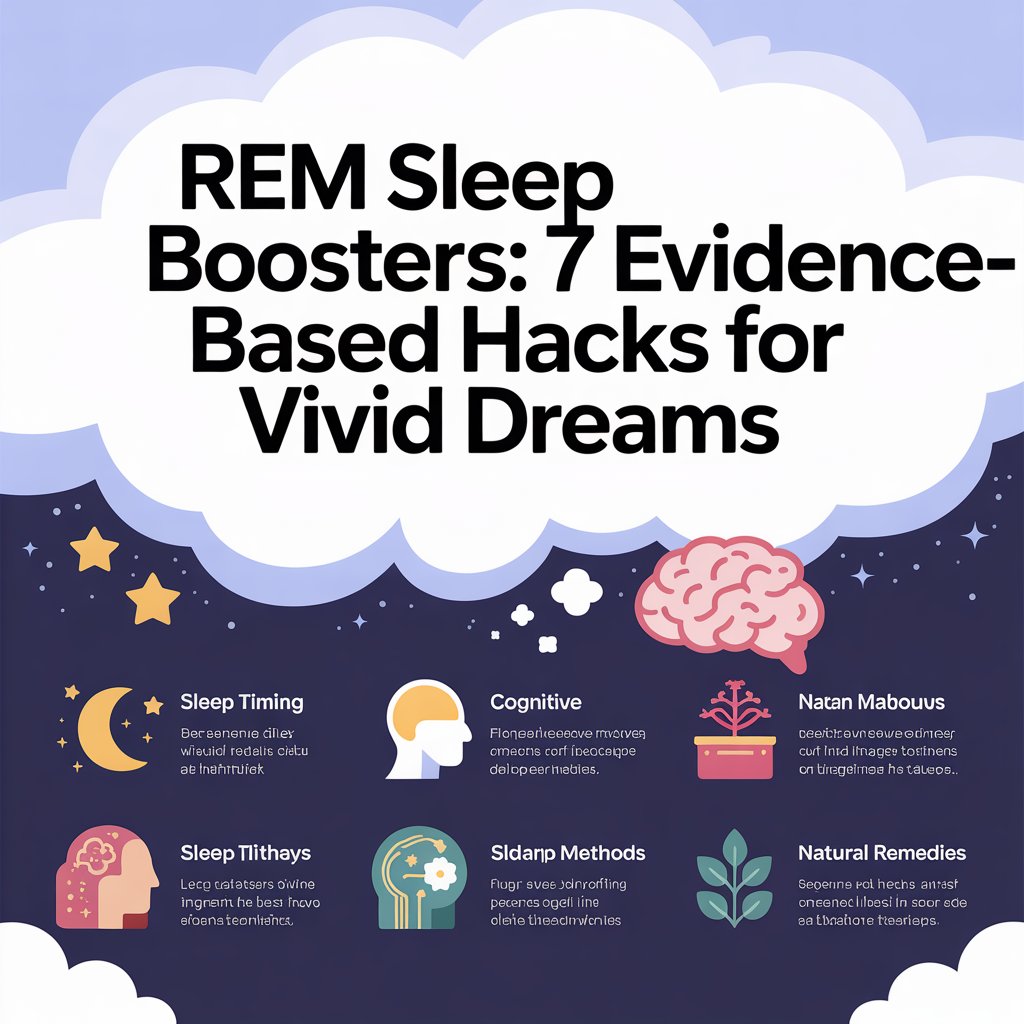
The good news: you don’t need a lab or a prescription to upgrade your dream life. Small, science-backed adjustments to your schedule, environment, nutrition, and mindset can meaningfully boost REM sleep and sharpen dream recall. Below are 7 evidence-based REM sleep boosters — from sleep-hygiene fundamentals to targeted memory reactivation — explained in plain English with practical steps, dosing notes, and safety caveats.
Ready to turn your nights into something worth remembering? Let’s dive in.
A Quick Primer: What Is REM Sleep, Really?
REM sleep is the lightest yet most cognitively active stage of sleep. It typically first appears about 90 minutes after you fall asleep and recurs every 90–120 minutes across the night, with each REM period getting longer — the final one can last 45–60 minutes. That’s why your most vivid dreams tend to hit in the early morning hours.
Physiologically, REM is marked by three signatures: rapid eye movements under your eyelids, muscle atonia (temporary paralysis that keeps you from acting out dreams), and brain-wave activity that looks nearly identical to wakefulness on an EEG. Heart rate and breathing become irregular, and the limbic system — your emotional command center — lights up while the prefrontal cortex, responsible for logical reasoning, quiets down. That neurochemical cocktail is precisely why dreams feel so emotionally intense and narratively bizarre.
A healthy adult accumulates roughly 90–120 minutes of REM per night across four to five cycles. REM duration naturally declines with age — older adults may see REM drop by 20–50% — and it’s highly sensitive to alcohol, cannabis, sleep fragmentation, and certain medications like SSRIs.
Hack #1: Optimize Your Sleep Schedule and Continuity
The single most reliable way to boost REM sleep is, ironically, the least glamorous: go to bed and wake up at the same time, every day, and give yourself enough total hours in bed. Because REM periods grow longer later in the night, trimming sleep from seven hours to six can slash your total REM time by up to 25% — you’re essentially chopping off the most dream-rich phase.
The American Academy of Sleep Medicine (AASM) recommends 7–9 hours for adults, paired with a consistent wake time even on weekends. A 2021 longitudinal study in Sleep found that adults with irregular sleep schedules (bedtime variance >90 minutes) reported significantly poorer dream recall and lower subjective sleep quality than consistent sleepers.
How to apply it:
- Pick a fixed wake time and protect it ruthlessly — yes, Saturdays too.
- Count back 8–8.5 hours (to buffer 15–30 minutes of sleep latency) and set that as your target bedtime.
- Avoid “sleep banking” or dramatic weekend shifts; jet-lag-like variance resets your circadian rhythm weekly.
- If you wake at night, stay in bed and practice slow breathing — fragmentation is the enemy of long REM cycles.
Key takeaway: Consistency compounds. Give your brain predictable, long windows, and it rewards you with the richest dream sequences of the week.
Hack #2: Practice REM-Enhancing Sleep Hygiene
Your bedroom environment can either invite deep, uninterrupted REM or sabotage it. REM is especially vulnerable to temperature spikes, light exposure, and stimulation — all of which can pull you into lighter sleep or fully awake.
Research shows that core body temperature naturally drops by about 1–2°F during sleep, and warmer ambient temperatures suppress REM and increase awakenings. Similarly, even brief blue-light exposure before bed delays melatonin onset by up to 90 minutes, compressing your early REM window.
How to apply it:
- Cool the room to 60–67°F (15.5–19.5°C); use breathable cotton or linen bedding.
- Blackout the room completely — cover LEDs on chargers and alarm clocks.
- Dim screens 90 minutes before bed and enable warm-light filters; consider blue-light-blocking glasses if you must work late.
- Build a wind-down ritual — 20 minutes of reading, stretching, or a warm shower (which paradoxically cools core temperature afterward via vasodilation).
- Avoid alcohol within 3 hours of bed. It fragments second-half sleep and drastically reduces REM rebound.
Key takeaway: Think of your bedroom as a dream incubator. Dark, cool, quiet, and screen-free is the formula.
Hack #3: Use Targeted Nutrition and Supplements
What you eat and drink in the hours before bed can tilt sleep architecture toward more REM — or away from it. A few nutritional levers stand out in the research.
Carbohydrate timing. A small 2022 study in Nutrients found that a modest complex-carb snack (about 30g) 60–90 minutes before bed increased REM percentage compared with a high-protein snack, likely by supporting tryptophan uptake and serotonin synthesis.
Vitamin B6. A randomized, placebo-controlled trial published in Perceptual and Motor Skills showed that 240 mg of vitamin B6 taken 30 minutes before bed significantly increased dream recall and vividness without disrupting overall sleep quality.
Melatonin. While primarily a sleep-onset aid, low-dose melatonin (0.3–1 mg) can consolidate REM cycles. Anecdotal and some clinical reports link 3–5 mg doses to unusually vivid or bizarre dreams, though higher doses may cause grogginess.
Other options with emerging evidence: magnesium glycinate (for relaxation), L-theanine (200 mg), and galantamine — a cholinergic agent used in lucid-dreaming protocols, best reserved for experienced practitioners and taken after 4–5 hours of sleep.
How to apply it:
- Evening snack: 1 banana with 1 tbsp almond butter, or oatcakes with hummus — complex carbs plus a little protein.
- Vitamin B6: 100–240 mg, ~30 minutes before bed. Do not exceed 200 mg/day long-term without medical oversight (risk of peripheral neuropathy).
- Melatonin: Start at 0.3–1 mg; increase only if needed.
Key takeaway: Nutrition fine-tunes REM, it doesn’t replace it. Always pair supplements with solid sleep hygiene — and consult your provider before adding anything, especially if you take medications.
Hack #4: Try Sleep Restriction and Strategic Naps
This one sounds counterintuitive: can less sleep produce more vivid dreams? Under specific conditions, yes — thanks to a phenomenon called REM rebound.
When you’re mildly REM-deprived (from a short night, an early alarm, or a period of sleep restriction), your brain compensates on subsequent nights by entering REM faster and spending more time in it. This is the same mechanism behind the intense dreams people report after periods of high stress or fragmented sleep — only now, you’re harnessing it intentionally.
Strategic napping also triggers rebound-like effects. A 20-minute nap taken after a REM-light night can produce unusually vivid, hypnagogic imagery as the brain dips quickly into REM. However, naps longer than 30 minutes often cause sleep inertia, and naps after 3 PM can suppress nighttime REM.
How to apply it:
- Don’t overdo restriction. One short night (5–6 hours) is usually enough to trigger rebound; chronic restriction harms health and memory.
- Time naps: 1–3 PM, for 20 minutes max. Set an alarm.
- Pair with intention-setting: Before the nap, tell yourself, “I will remember my dream.” This primes recall.
- Use sparingly — once or twice per week, not as a lifestyle.
Safety note: Sleep restriction is contraindicated for people with mood disorders, epilepsy, or driving-heavy jobs. When in doubt, skip it.
Key takeaway: REM rebound is real, but it’s a spice, not a main course. Use strategically.
Hack #5: Dream Journaling and Reality Checks
If you only adopt one hack from this list, make it this one. Dream journaling is the single most validated behavioral technique for improving dream recall, and it works for nearly everyone who does it consistently.
The mechanism is simple: dreams fade from short-term memory within seconds of waking. By capturing them immediately, you train your hippocampus to treat dreams as remember-worthy information. A 2017 study in Dreaming found that participants who journaled for two weeks doubled their weekly dream-recall frequency compared with controls.
Reality checks — brief mental pauses during the day where you ask, “Am I dreaming?” and test it (try pushing a finger through your palm, check a clock twice) — build a habit of meta-awareness that bleeds into sleep. Combined with journaling, they’re the core of most lucid dreaming tips shared by sleep researchers.
Meet Sarah, 34, a product designer in Austin. After years of “dreamless” sleep, she committed to a bedside journal and three daily reality checks. Within three weeks, she was recalling 4–5 dreams per week — one of which contained a visual metaphor that unlocked a stalled design project. “It felt like unlocking a second brain,” she said.
How to apply it:
- Keep a notebook and pen by the bed. Don’t reach for your phone first — light kills recall.
- Record within 60 seconds of waking. Even fragments count: a color, an emotion, a face.
- Do 3–5 reality checks daily, paired with a routine trigger (checking the time, walking through a doorway).
- Review your journal weekly to spot recurring themes and “dream signs.”
Key takeaway: The skill of remembering dreams is like a muscle. Journal it into shape.
Hack #6: Audio-Visual Stimulation and Targeted Memory Reactivation
This is where sleep science gets genuinely sci-fi. Targeted Memory Reactivation (TMR) is a technique in which a specific sound, scent, or image presented during learning is replayed during slow-wave or REM sleep — strengthening the associated memory and, in some protocols, influencing dream content.
A landmark study from Northwestern University and subsequent work published in Nature Neuroscience demonstrated that replaying learning-associated sounds during sleep boosted memory consolidation by 10–20%. More recently, studies from the University of Bern showed that TMR cues played during REM increased the likelihood that participants dreamed about the cued topic — a direct route to enhancing dreaming with purpose.
Audio-visual entrainment — binaural beats in the theta (4–8 Hz) or low-alpha range played at low volume as you drift off — has mixed but promising evidence for inducing hypnagogic imagery and supporting lucid-dream onset.
How to apply it:
- Learn with a cue: While practicing a skill or studying, play a distinctive sound (a chime, a specific track).
- Replay the cue softly during sleep using a sleep-timer-equipped app. Keep volume low enough to avoid waking yourself.
- Binaural beats: Try 4–7 Hz theta tracks at very low volume during your wind-down. Use sleep-safe earbuds or a pillow speaker.
- Devices: Stick to CE/FCC-certified sleep headbands or under-pillow speakers. Avoid bright light masks — even closed eyelids transmit light to the retina.
Key takeaway: Cue your brain with intention. Pair a sound with a waking task, then replay it in sleep to invite relevant dreams.
Hack #7: Mindfulness, Meditation, and Cognitive Techniques
Perhaps the most elegant REM sleep boosters are the ones that cost nothing: meditative and cognitive techniques practiced in the minutes before sleep.
Research from the University of Adelaide found that people with consistent mindfulness practices report significantly higher dream recall and lucidity. The likely mechanism: meditation strengthens the same prefrontal meta-awareness that’s needed to “wake up” inside a dream.
Two techniques stand out:
- MILD (Mnemonic Induction of Lucid Dreams): Developed by Dr. Stephen LaBerge, MILD involves setting a firm intention as you fall asleep — “Tonight, I will realize I’m dreaming” — while visualizing a recent dream and rehearsing recognizing it as a dream.
- WILD (Wake-Initiated Lucid Dream): A more advanced technique in which you maintain conscious awareness as you transition into sleep, often during a middle-of-the-night awakening. It can produce extremely vivid, lucid dreams but requires practice.
How to apply it:
- Wind-down meditation: 10 minutes of breath-focused or body-scan practice before bed.
- MILD intention: Repeat a phrase (“I will remember my dream”) 10–20 times as you feel sleep approaching.
- WILD attempts: Best attempted after 4–5 hours of sleep, during a natural awakening. Stay still, observe hypnagogic imagery, and allow sleep to take you without losing awareness.
- Combine with journaling for a multiplicative effect.
Key takeaway: Train your waking awareness and it will follow you into dreams.
When Vivid Dreams Aren’t a Good Thing
Not all vivid dreaming is a feature — sometimes, it’s a bug worth investigating.
Nightmares occurring more than once per week, especially if accompanied by daytime distress, may signal anxiety, PTSD, or medication side effects. SSRIs (selective serotonin reuptake inhibitors like sertraline and escitalopram) are notorious for producing intense, often disturbing dreams by suppressing REM and triggering rebound when levels fluctuate.
REM Sleep Behavior Disorder (RBD) is a more serious condition in which muscle atonia fails during REM, causing people to physically act out dreams — sometimes violently. It’s strongly linked to later development of Parkinson’s disease and requires evaluation by a sleep specialist. If you or your partner notice limb thrashing, shouting, or dream-enactment behaviors, book an appointment.
Fragmented sleep, severe daytime fatigue, or dreams that leave you more exhausted than rested are also red flags. Conditions like sleep apnea repeatedly interrupt REM, and vivid dream recall in those cases is often a sign of poor sleep, not rich sleep.
When to seek help:
- Nightmares more than once weekly, or causing avoidance of sleep
- Dream enactment behaviors (kicking, punching, shouting)
- Daytime sleepiness despite 7+ hours in bed
- Sudden change in dream intensity after starting a new medication
See a board-certified sleep medicine physician. Polysomnography (an in-lab sleep study) is the gold standard for diagnosis.
Your 7-Day REM Sleep Starter Plan
Want to put everything together without getting overwhelmed? Here’s a simple week-long rollout:
| Day | Focus | Action |
|---|---|---|
| 1–2 | Sleep schedule | Set a fixed wake time (+/- 30 min, even weekends). Target 8 hours in bed. Begin dimming screens 90 min before bed. |
| 3 | Environment | Cool the room to 65°F, blackout windows, silence LEDs. Start a dream journal at bedside. |
| 4 | Nutrition + journaling | Add a small complex-carb snack 90 min before bed + 100 mg B6. Write fragments on waking. Begin 3 daily reality checks. |
| 5 | Strategic nap | Take a 20-min nap between 1–3 PM. Set a pre-nap dream intention. |
| 6 | TMR trial | Pair a unique sound with a daytime learning task. Replay softly during sleep with a timer. |
| 7 | Cognitive technique | Try MILD at bedtime or WILD during a middle-of-night awakening. Review the week’s journal entries. |
Track three metrics daily:
- Dream recall frequency (how many dreams remembered)
- Dream vividness (1–5 scale)
- Daytime alertness (1–5 scale)
By day 14, most practitioners see recall frequency double. Adjust based on what works — and drop what doesn’t.
Sweet Dreams Are Made of These
Vivid dreaming isn’t just a quirky neurological side effect — it’s a window into how your brain integrates memory, emotion, and creativity. The seven REM sleep boosters above are grounded in sleep science, safe for most healthy adults, and scalable to your lifestyle.
Start small: consistent sleep, a bedside journal, and a cool, dark room will take you further than any supplement alone. Add in targeted nutrition, strategic naps, TMR cues, and meditative techniques as your practice deepens — and always listen to your body. If vivid dreams turn distressing or your sleep feels unrefreshing, consult a sleep professional.
For deeper reading, visit the American Academy of Sleep Medicine, Sleep Foundation, and peer-reviewed research via PubMed.
Want to start tonight? Download our free Dream Journal Template (printable + digital) and subscribe for weekly sleep-science tips delivered to your inbox. Your best dreams are one night away.
⚠️ Disclaimer: This article is for informational purposes only and does not constitute medical advice. Consult a licensed healthcare provider before starting any supplement, particularly if you take prescription medications, are pregnant, or have a diagnosed sleep or mental health condition.