Feeling that midafternoon drag yet again—slowed typing, heavy eyelids, and a stubborn lack of focus? You’re not alone. Millions of busy Americans experience a predictable energy dip in the early afternoon, whether you’re grinding through a content editing session, studying for finals, or gearing up for an evening Twitch stream.
The good news: a short, well-timed power nap can be a scientifically supported reset button, improving alertness, memory, and mood without wrecking your nighttime sleep. But not all naps are created equal. Fall asleep for the wrong amount of time, and you’ll wake up feeling groggier than before—a frustrating phenomenon known as sleep inertia.
In this comprehensive guide, we are breaking down the exact science of napping. You’ll learn the ideal nap lengths, the best time of day to close your eyes, and practical, real-world hacks (including the popular “caffeine nap”) that deliver fast, reliable energy boosts. Whether you are a busy professional navigating back-to-back Zoom calls or a gig worker trying to maximize daytime efficiency, mastering your midday rest is a total game-changer.
What is a power nap?
At its core, a power nap is a brief period of sleep—typically lasting between 10 and 20 minutes—taken during your waking hours to quickly restore alertness and energy. Unlike a full night’s sleep, which cycles through multiple complex phases, a true power nap is designed to keep you in the lighter stages of sleep.
To understand why this matters, we need to briefly look at human sleep architecture. Sleep is divided into two main categories: Non-Rapid Eye Movement (NREM) and Rapid Eye Movement (REM). NREM is further broken down into three stages. Stage 1 and Stage 2 are light sleep, where your heart rate slows, your body temperature drops, and your brain begins to disconnect from external stimuli.
Stage 3 is slow-wave sleep (SWS), the deep, restorative phase where tissue repair and immune strengthening occur. Finally, REM sleep is where vivid dreaming and emotional processing happen.
When you nap for too long—say, 45 minutes to an hour—you risk entering slow-wave sleep. Waking up from this deep stage is what causes sleep inertia, that heavy, disoriented, “zombie-like” feeling that can take an hour or more to shake. A perfectly executed power nap allows you to reap the restorative benefits of Stage 1 and Stage 2 light sleep, boosting cognitive function and clearing out mental fatigue without ever crossing the threshold into deep, groggy slow-wave sleep.
How naps boost energy and focus
The benefits of napping aren’t just anecdotal; they are backed by decades of rigorous scientific research. Organizations like NASA, the CDC, and the NIH have all explored how daytime sleep impacts human performance.
One of the most famous pieces of research is the NASA nap study conducted on military pilots and astronauts. The study found that a brief 40-minute nap improved flight crew performance by 34% and alertness by 100%. While 40 minutes edges into deeper sleep territory for the average person, it underscores a massive truth: naps are a potent performance-enhancing tool.
Beyond alertness, studies published in the Journal of Sleep Research and various NIH/PubMed reviews highlight that napping significantly aids in memory consolidation. When you learn a new skill—whether it’s coding a new app, memorizing medical terminology, or mastering a new video game map—your brain needs time to encode that information. A short nap acts as a “save button” for your brain, moving information from the short-term hippocampus to the more permanent storage of the neocortex.
Furthermore, napping has measurable cardiovascular and emotional benefits. A study out of Allegheny College found that participants who napped after a stressful task had lower blood pressure and heart rates during recovery compared to those who stayed awake. Mood regulation is another massive perk; a quick snooze can reset emotional reactivity, making you less irritable and more resilient to afternoon stressors.
The science: circadian dips and sleep stages
But why do we feel the need to nap in the first place? The answer lies in two biological mechanisms: homeostatic sleep pressure and circadian rhythms. From the moment you wake up, a chemical called adenosine builds up in your brain, creating “sleep pressure.” The longer you are awake, the stronger the urge to sleep.
Simultaneously, your circadian rhythm—your internal 24-hour biological clock—experiences a natural dip in core body temperature and alertness between 1:00 PM and 3:00 PM. This is often mistakenly blamed entirely on a heavy lunch (the “post-lunch dip” or “food coma”), but it is actually a hardwired evolutionary trait.
Interestingly, age plays a role in how naps affect us. According to sleep medicine reviews, older adults tend to experience more fragmented nighttime sleep, making daytime napping more common and sometimes necessary for cognitive maintenance. However, young adults and busy professionals often use naps purely as a strategic tool to offset sleep debt and maximize peak performance.
Understanding these biological underpinnings proves that fighting the afternoon slump with sheer willpower or a third cup of coffee is often a losing battle. Science suggests we should lean into our biology, not fight it.
Best nap length: 10, 20, 60, or 90 minutes?
If you want to maximize the benefits and avoid the dreaded sleep inertia, precision is everything. Both the length of your nap and the time of day you take it must align with your sleep cycles.
- 10 to 20 Minutes (The Classic Power Nap): This is the gold standard for a quick energy boost. You stay entirely in light NREM sleep (Stages 1 and 2). You will wake up feeling instantly refreshed, sharper, and more alert, with zero grogginess. Research consistently shows that 10-minute naps produce immediate improvements in cognitive performance and vigor.
- 30 Minutes (The Danger Zone): A half-hour nap often allows your brain to transition into slow-wave deep sleep. If your alarm goes off at the 30-minute mark, you are highly likely to experience sleep inertia. It is generally best to avoid this duration unless you have time to push through to a full cycle.
- 60 Minutes (The Memory Booster): A 60-minute nap includes slow-wave sleep. While you will likely wake up feeling very groggy, this length is excellent for memory consolidation, particularly for remembering facts, places, and faces. It’s ideal for students cramming for an exam, provided you have an hour to wake up fully afterward.
- 90 Minutes (The Full Cycle): This allows you to complete a full sleep cycle, including REM sleep. Waking up at the end of a 90-minute cycle usually leaves you feeling refreshed because you are naturally exiting REM sleep. This nap boosts creativity, emotional memory, and procedural memory (like learning to play an instrument or mastering a new sport).
When to nap: timing that works for most US schedules
For most Americans operating on a standard schedule across Eastern, Central, Mountain, or Pacific time zones, the optimal window for a nap is between 1:00 PM and 3:00 PM. This perfectly aligns with the natural circadian dip mentioned earlier. Napping during this window capitalizes on your body’s natural drop in alertness, making it easier to fall asleep quickly.
Timing is also about protecting your nighttime sleep drive. If you nap too late in the day—say, after 4:00 PM—you risk relieving too much of your homeostatic sleep pressure. This can lead to difficulty falling asleep at your normal bedtime, creating a vicious cycle of nighttime insomnia and daytime fatigue. Keep your naps early, keep them short, and protect your nighttime rest.
12 practical hacks to nap better (pre-nap, during, and post-nap)
Knowing the science is only half the battle; executing the nap in the real world requires strategy. Here are 12 actionable hacks to optimize your midday rest.
Pre-Nap Hacks
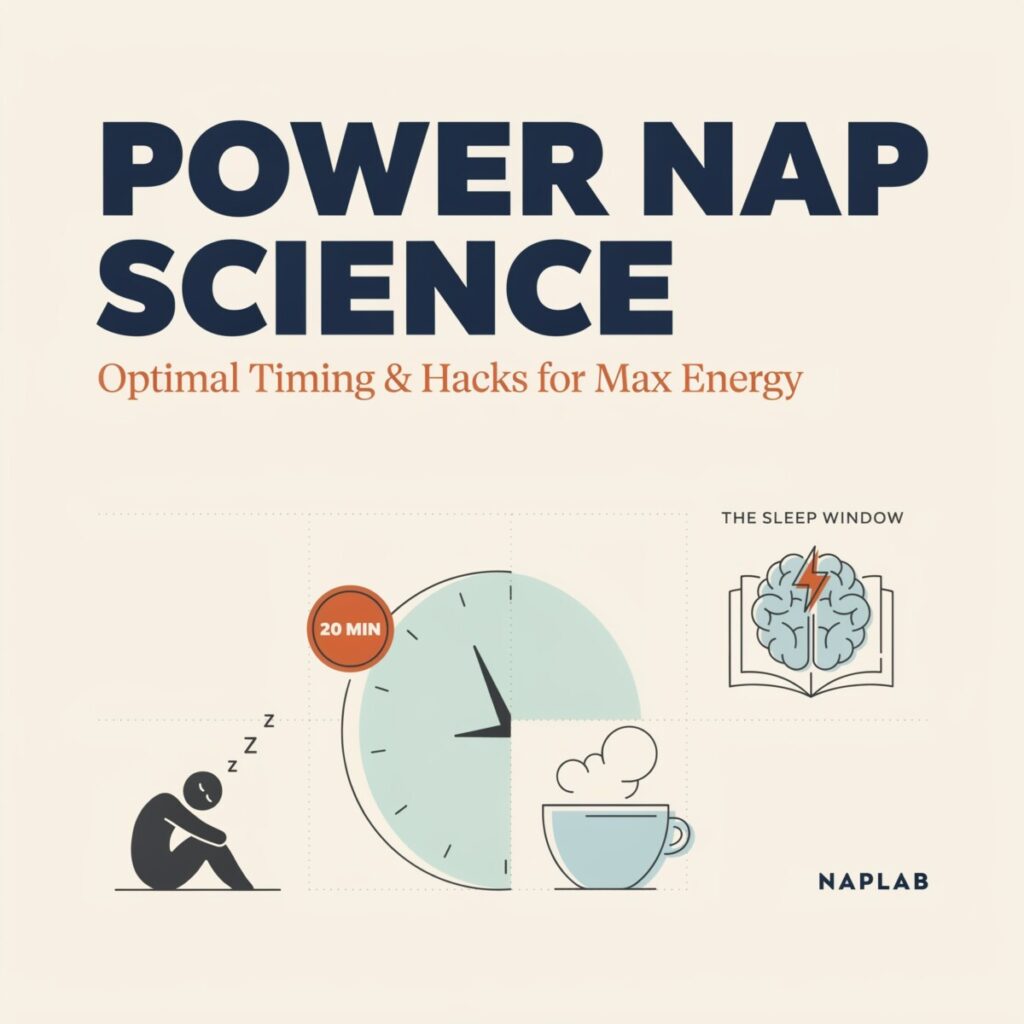
- The “Nappuccino” (Caffeine Nap): Caffeine takes about 20 to 25 minutes to cross the blood-brain barrier. By drinking a cup of coffee immediately before laying down for a 20-minute nap, the caffeine kicks in exactly as you are waking up. You get the dual benefit of clearing out adenosine through sleep and blocking remaining receptors with caffeine.
- Cool the Room: Drop the room temperature slightly (around 65°F to 68°F is ideal for sleep onset). A cooler environment signals to your body that it is time to rest.
- Block the Light: Dim the lights or use a high-quality sleep mask. Darkness stimulates melatonin production, helping you fall asleep faster.
- Set a Hard Alarm: Always set an alarm for 25 minutes out (allowing 5 minutes to fall asleep and 20 minutes to snooze) so you don’t oversleep into deep sleep territory.
During the Nap
- Support Your Neck: If you are at a desk, a supportive neck pillow or a specialized desk-nap pillow can prevent neck strain and tension headaches.
- Recline When Possible: If you have access to a couch or a reclining chair, lie flat to lower your heart rate more effectively than sitting upright.
- Use Audio Blocking: Use noise-canceling headphones or earplugs to block out office chatter. Listen to white noise or pink noise to mask disruptive background sounds.
- Try Guided Apps: Guided nap apps like Slumber or Calm offer specific 10-to-20-minute “power down” tracks that gently wake you up with soothing chimes, removing the anxiety of oversleeping.
Post-Nap Hacks
- Seek Bright Light: Immediately expose yourself to bright light. Step outside into the sunlight or turn on bright, cool-toned LED lights to halt melatonin production.
- Get Moving: Do a quick 5-minute physical reset. Take a brisk walk around the block or do some light stretching to get your blood flowing.
- Hydrate Immediately: Drink a large glass of water to rehydrate your brain and shake off the physical sluggishness of sleep.
- Do a Cognitive Warm-Up: Don’t jump straight into complex problem-solving. Start with a simple, low-stakes task like clearing out your email inbox for the first 10 minutes to shake off any residual grogginess.
A Note on Workplace Naps: If your workplace has nap pods or designated quiet rooms, use them! If not, get creative. Many professionals use their cars during lunch breaks, reclining the seat and using a sunshade for privacy. Always communicate your boundaries; a simple “Do Not Disturb” sign or a blocked-out calendar slot labeled “Focus Time” can protect your 20-minute reset from well-meaning coworkers.
Who should skip or limit naps
While power naps are a fantastic tool for the majority of the population, they are not a universal prescription. For some individuals, daytime napping can actually do more harm than good.
If you suffer from chronic insomnia, napping during the day can severely diminish your homeostatic sleep drive, making it even harder to fall asleep or stay asleep at night. Sleep medicine specialists generally advise insomniacs to avoid naps entirely to consolidate their sleep into a single, solid nighttime block.
Additionally, individuals with certain sleep disorders, such as obstructive sleep apnea (OSA), should be cautious. Napping can sometimes exacerbate the symptoms of sleep apnea or mask the severity of nighttime breathing interruptions.
If you find that you are getting a full eight hours of sleep at night but still feel an overwhelming, uncontrollable urge to nap during the day, or if you wake up from naps feeling unrefreshed and with a dry mouth, it is time to consult a doctor or a sleep specialist. Relying heavily on naps just to function could be a red flag for an underlying sleep pathology that requires professional intervention rather than a quick afternoon snooze.
3 nap routines you can try today
Ready to put this into practice? Here are three tailored nap routines you can use today.
- The Student Cram-Session Nap: You have a massive biology exam tomorrow. Read your study materials for 45 minutes, then drink a glass of ice water and set an alarm for 20 minutes. Close your eyes. When the alarm rings, immediately get up, review your notes while standing, and take a 5-minute walk. Benefit: Enhances memory consolidation of the facts you just read without causing brain fog.
- The Office Power-Up Nap: It’s 2:00 PM and you have a 3:00 PM client presentation. Drink a quick espresso, put on noise-canceling headphones playing pink noise, and rest your head on a desk pillow or head to your car. Set a 25-minute alarm. Post-nap, splash cold water on your face and do some light desk stretches. Benefit: Sharpens vocal delivery, alertness, and reaction time for the meeting.
- The Gamer/Streamer Pre-Stream Nap: Before a 4-hour evening Twitch stream, take a full 90-minute nap around 4:00 PM. This allows for a complete sleep cycle, including REM sleep. Benefit: Boosts creativity, emotional regulation (keeping you from raging at teammates), and sustained reaction times for the long broadcast.
Final tips and next steps
Mastering power nap timing is one of the most effective, zero-cost biohacks available to modern professionals, students, and creators. By understanding your circadian rhythm and respecting your sleep stages, you can turn the dreaded afternoon slump into your secret weapon for peak productivity.
Your 3 Actionable Takeaways:
- Keep it short: Aim for 10 to 20 minutes to stay in light sleep and avoid sleep inertia.
- Time it right: Nap between 1:00 PM and 3:00 PM to align with your natural circadian dip and protect your nighttime sleep.
- Try the caffeine nap: Drink a cup of coffee right before your 20-minute nap for a compounded energy boost upon waking.
Next Steps: Try a 15-to-20-minute caffeine nap this week. Track your midday energy, focus, and evening productivity for 7 days, and watch how a simple science-backed reset completely transforms your afternoon hustle.