Here’s a number that should bother you: more than one in three American adults don’t get enough sleep on a regular basis, according to the CDC. We blame our phones, our jobs, our kids, our caffeine—and all of those matter. But there’s one sleep thief hiding in plain sight that almost nobody talks about: the temperature of your bedroom.
A landmark 2012 study published in the journal Neurobiology of Aging found that warming the skin by less than 1∘F before bed reduced nighttime awakenings and dramatically increased deep sleep—without changing anything else in the participants’ routines. Other research suggests that the ideal bedroom temperature for sleep hovers around 65∘F, give or take a few degrees, while a poorly timed room temperature can double how long it takes you to drift off.
In other words, your thermostat may be the single most powerful—and most neglected—sleep tool in your home.
In this guide, you’ll learn exactly how temperature affects sleep, why a warm shower before bed actually cools you down, and a handful of science-backed temperature hacks you can start tonight. No expensive gadgets required (though we’ll mention the ones worth it).

How Sleep and Body Temperature Are Linked
Your body doesn’t just happen to fall asleep at night. Sleep is choreographed by your circadian rhythm—a roughly 24-hour internal clock that orchestrates everything from hormone release to hunger to the heat your body produces and sheds.
Temperature is not a side effect of sleep. It’s one of the signals that triggers it.
The Core-Temperature Curve
If you tracked your core body temperature continuously over 24 hours, you’d see a smooth curve. It peaks in the late afternoon (around 4–6 p.m.), then begins a slow descent starting in the evening. That decline isn’t subtle—your core drops by roughly
ΔTcore≈1–2∘F
as you transition from wakefulness into the first stage of sleep, and it bottoms out around 4–5 a.m., a couple of hours before you wake.
This drop isn’t just correlated with sleep. It’s required for it. Your brain uses the falling core temperature as a “time-to-shut-down” signal for the systems that govern sleep architecture—the cycling through light, deep, and REM sleep that makes a night of rest actually restorative.
🧠 The deeper science: your brain’s built-in thermostat
The thermostat itself lives in a walnut-sized region of the brain called the hypothalamus, specifically a pocket called the preoptic anterior hypothalamus. This area is packed with temperature-sensitive neurons that constantly measure the heat of the blood flowing past them and adjust your body’s response accordingly.
When those neurons detect rising heat, they trigger vasodilation—your body’s way of widening blood vessels near the skin (especially in your hands, feet, and face) to dump excess warmth into the environment. That’s why your fingertips feel warmer right as you get sleepy. When the neurons detect cold, they do the opposite: vasoconstriction plus shivering.
The clever part? These same neurons also regulate the flip from waking to sleeping. So when your skin is gently warm and your core is gently cooling, the hypothalamus reads that combo as a green light: “Conditions are safe. Time for sleep.” That biological overlap is why temperature and sleep are so tightly wired together—and why you can hack one to influence the other.
Hands, Feet, and the Magic of Heat Dumping
The reason the evening temperature drop matters is that sleep requires your body to shed heat fast. And the fastest way to do that is through peripheral cooling—letting warmth escape through your extremities.
When you lie down in a cool room, blood vessels in your hands and feet dilate, and warm blood from your core circulates outward, releasing heat through the skin. This process, called heat dissipation, is the main way your core temperature falls.
That’s also why sleeping with your feet outside the blanket works so well for so many people. It isn’t a quirky habit—it’s physiology.
Melatonin Gets Involved, Too
As evening wears on and your brain’s master clock cues the release of melatonin, the hormone helps coordinate the temperature drop. Melatonin doesn’t just make you drowsy; it directly supports vasodilation in the skin, which accelerates the cooling your body is already trying to do. That’s one reason bright screens late at night are so disruptive—they suppress melatonin release, which in turn slows the temperature drop that sleep depends on.
What the Research Actually Says
Scientists have been studying how temperature affects sleep for decades, and the results converge on a handful of reliable findings.
📚 Key studies worth knowing
- Warm skin, deeper sleep (2012, Neurobiology of Aging). Researchers in the Netherlands gave older adults a thermoregulating suit that warmed their skin by just 0.7∘F overnight. The result? Fewer early-morning awakenings and a measurable increase in slow-wave (deep) sleep—without any change in core body temperature.
- The warm-bath meta-analysis (2019, University of Texas at Austin). A review of 17 previous studies confirmed that a warm bath or shower (about 104–109∘F) taken 1 to 2 hours before bed shortened sleep onset latency by an average of 10 minutes and improved overall sleep efficiency.
- Cool rooms improve sleep (multiple). Sleep Foundation guidelines, supported by work at the University of Pittsburgh and others, put the best bedroom temperature for sleep between 60 and 67∘F, with a sweet spot around 65∘F.
- Peripheral cooling for insomnia (2007, Sleep). A University of Pittsburgh study found that mild cooling of the scalp—using a water-cooled cap—reduced brain metabolic activity and helped people with primary insomnia fall asleep as quickly as healthy controls.
The Warm-Shower Paradox
The most counterintuitive finding—and the basis of the now-famous warm shower sleep hack—is that warming yourself up before bed actually helps you cool down for sleep. Here’s why: a short warm bath, shower, or foot soak dilates blood vessels in your skin. The moment you step out into cooler bedroom air, that dilated network of vessels dumps heat rapidly, accelerating the core-temp drop your body was already trying to achieve.
You get the signal without the sweat.
Targeted Cooling Works—Especially for Insomnia
Researchers like Dr. Eric Nofzinger at the University of Pittsburgh have shown that peripheral cooling—of the scalp, hands, or feet—can quiet the “racing brain” that keeps insomniacs awake. Cooling slows the metabolic activity in the prefrontal cortex, the region most associated with rumination and worry. This is the science behind the growing category of cooling mattresses, pillowcases, and headbands marketed to hot sleepers.
The Room-Temperature Sweet Spot
Across studies on healthy adults, the ideal bedroom temperature for both sleep onset and sleep quality is consistently in the mid-60s Fahrenheit. Rooms above about 75∘F reliably fragment sleep, reduce REM, and cut deep sleep. Rooms below about 54∘F don’t usually help—and can backfire by triggering the body to shiver, which raises core temperature.
Practical Temperature Hacks (Try One This Week)
Now the useful part. Here are the habits, tweaks, and tools that translate the research into your actual bedroom. Pick one or two to start. Changing everything at once makes it impossible to know what worked.
1. Dial in the Bedroom Thermostat
- Target: 60–67∘F (roughly 15.5–19.5∘C), with 65∘F as a first guess.
- Why: This range supports the natural core-temp drop and prevents your body from fighting heat during deep sleep.
- Don’t: Go below ~54∘F or above ~75∘F. Extreme temps fragment sleep.
- Pro tip: If you share a bed, split the difference or use separate bedding layers (see next section) rather than forcing one thermostat setting on both of you.
2. Build a “Temperature Layer Cake” with Bedding and PJs
Instead of betting on one heavy comforter, layer up so you can add or remove easily:
- Base layer: A fitted sheet in a breathable fabric—cotton percale, linen, or bamboo viscose.
- Middle layer: A light blanket you can kick off at 3 a.m.
- Top layer: A duvet or quilt appropriate for the season.
- Pajamas: Go for moisture-wicking pajamas or loose cotton. Skip polyester and heavy fleece if you run hot—they trap heat and humidity against your skin.
A small anecdote: a friend of mine—let’s call her Jen—spent two years convinced she had insomnia. She’d wake at 2 a.m. every night, wide awake, staring at the ceiling. On a whim she swapped her flannel sheets and fleece PJs for linen and cotton, then dropped the thermostat from 72 to 66∘F. She slept through the night on day three. Nothing about her diet, stress, or schedule had changed—just the temperature environment.
3. Take a Warm (Not Scalding) Shower 60–90 Minutes Before Bed
This is the warm shower sleep hack done right:
- Water temp: warm to comfortably hot (~104∘F), not steaming.
- Duration: 10 minutes max.
- Timing: 1 to 2 hours before you want to be asleep—not right before.
- Afterward: Step into a cool bedroom. That’s the trigger.
A warm foot bath works too if a full shower feels like too much. A 10-minute soak in a basin of warm water draws blood to the feet, and the heat dump happens the same way. This is one of the simplest warm bath before bed benefits to grab without committing to a full tub soak.
4. Cool the Room Smart
If you have AC, set it and trust it. If you don’t:
- Use a bedroom fan pointed at you (or better, pointed at a window to pull hot air out).
- Open windows on opposite sides of the home to create a cross-breeze.
- Freeze a water bottle and set it in front of the fan for a DIY AC.
- Keep blinds and curtains closed during the hottest part of the day.
- Avoid using the oven or running the dryer within 2–3 hours of bedtime.
For people wondering how to cool down to sleep quickly without a fancy setup, the fan-plus-ice-bottle trick is surprisingly effective.
5. Try Targeted Cooling on Extremities and Head
Peripheral cooling for better sleep is one of the most efficient ways to drop core temperature without making the whole room icy:
- Stick one or both feet out from under the covers.
- Keep a small ice pack or cold washcloth at the bedside; press it to your wrists, the back of your neck, or your forehead for 60 seconds as you settle in.
- Use a cooling pillowcase (many are made from phase-change fabric or bamboo) or a cooling mattress topper with gel or water channels.
6. Time It Right
The timing matters as much as the temperature:
| Time before bed | Do this |
|---|---|
| 2–3 hours | Stop exercising, stop heavy meals |
| 1–2 hours | Warm shower or foot bath |
| 30–60 minutes | Dim lights; start cooling the bedroom |
| At bedtime | Cool room, breathable layers, extremities exposed |
| Middle of the night | Don’t crank up the heat if you wake cold—add a layer instead |
7. Seasonal Adjustments
- Summer: Close blinds by day, open windows at night, use a fan pointed outward, keep a cold pack in the freezer.
- Winter: Don’t let your bedroom get above 70∘F just because the rest of the house is warm. Lower the thermostat at night, layer your bedding, and wear socks if your feet run cold (warm feet = faster sleep onset).
- No AC: Sleep on the lowest floor of your home. Take a lukewarm shower before bed—not cold, because a cold shower triggers shivering, which raises core temp.
Special Considerations: Shift Workers, Older Adults, Menopause, Kids
Not everyone’s thermostat is the same. A few groups deserve tailored advice.
- Shift workers: Your circadian rhythm is fighting the environment. Use blackout curtains, drop the bedroom temperature during your daytime sleep window (60–65∘F still applies), and consider a warm shower before your daytime sleep—not before your daytime wake-up—to cue the sleep transition.
- Older adults: Aging reduces thermoregulation sensitivity—you may not feel too warm even when your body is overheating. Use a room thermometer rather than guessing, and consider skin-warming strategies (warm socks, a light heated throw 30 minutes before bed, then turned off) that studies show specifically help older adults get more deep sleep.
- People experiencing hot flashes: Keep the bedroom on the cooler end (closer to 60–63∘F), use moisture-wicking bedding, keep a small fan on the nightstand, and avoid warm showers within two hours of bed—opt for a cool (not cold) rinse instead to minimize hot flashes overnight.
- Parents of young children: Toddlers and kids actually sleep best slightly warmer than adults—around 65–70∘F. Avoid bundled sleep sacks in a warm room; overheating is a genuine safety concern for infants. Check the back of their neck: cool and dry is ideal, sweaty means remove a layer.
Common Mistakes and Myths
A few myths keep people stuck in bad sleep:
- Myth: “Colder is always better.” No. Below ~54∘F, your body activates heat-generating mechanisms (shivering, vasoconstriction) that can disrupt REM sleep and knock you awake. A cooler room for sleep is great—but cool, not cold.
- Myth: “Heavy blankets ruin sleep.” Not for everyone. Weighted and heavy blankets help many people fall asleep faster through deep-pressure stimulation—especially in a cool room. The problem is overheating, not weight. Use a heavy but breathable blanket, or a weighted blanket made from cotton instead of polyester.
- Mistake: Cooling too early. Cranking the AC hours before bed in a poorly insulated room can overcool the space, leaving you shivering at sleep onset. Let the room cool with the outdoor temperature in the evening, then fine-tune ~30 minutes before bed.
- Mistake: Cold showers at night. A freezing shower triggers your sympathetic nervous system—alertness, adrenaline, shivering. It’s great at 6 a.m., lousy at 10 p.m. If you care about sleep quality, warm beats cold before bed, nearly every time.
Your 15-Minute Nightly Temperature Routine
Here’s a simple checklist to try for two weeks:
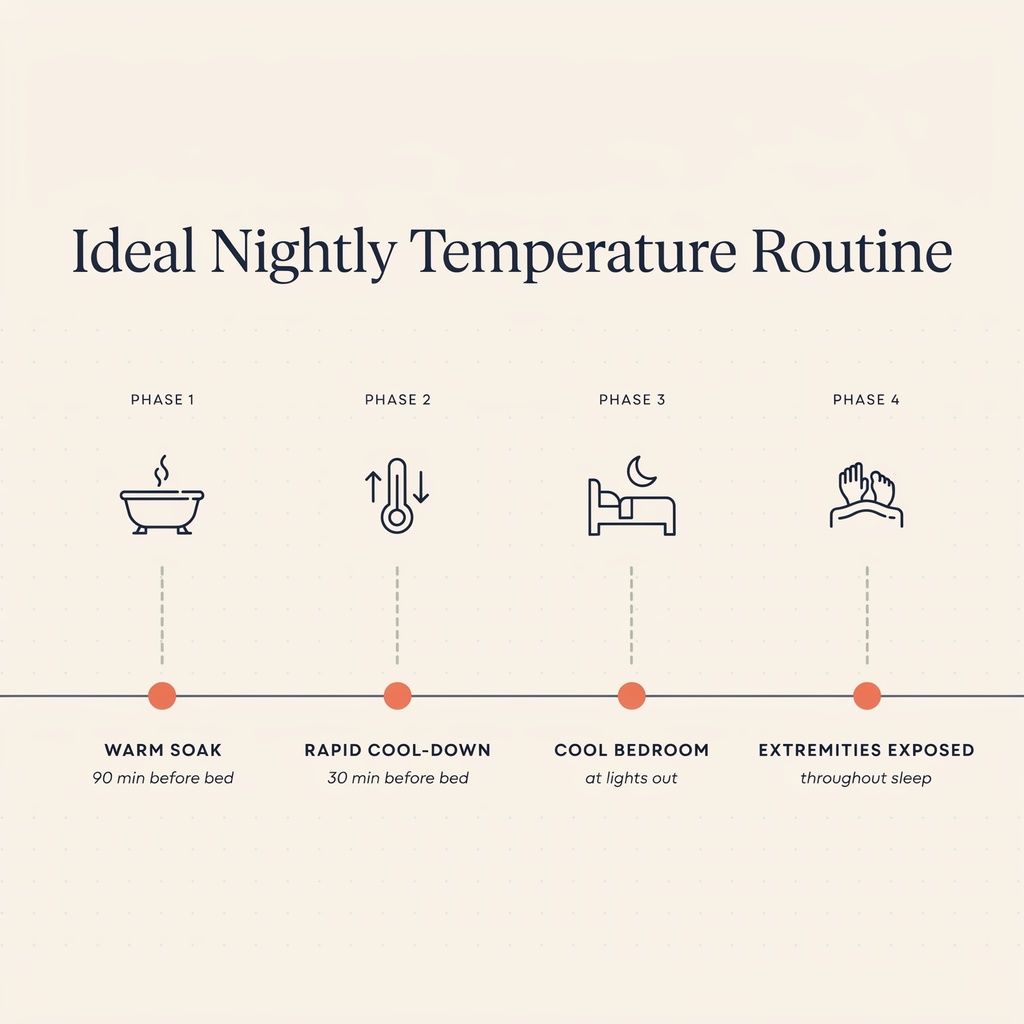
- 2 hours before bed: Take a 10-minute warm shower or foot soak.
- 1 hour before bed: Set the thermostat (or open windows) to 60–67∘F.
- 30 minutes before bed: Dim lights to protect melatonin release.
- At bedtime: Put on breathable cotton or moisture-wicking PJs; layer bedding so you can adjust.
- In bed: Stick feet out, or press a cool cloth to your wrists for 60 seconds.
- If you wake hot: Remove a layer, don’t drop the thermostat further.
- If you wake cold: Add socks or a light layer, don’t crank the heat.
The Takeaway
Temperature and sleep are not a side conversation—they’re the main one. Your brain is literally waiting for a cool core and warm skin as the signal to shut the day down. Most of us spend years optimizing our mattress, our pillows, and our screen-time rules, and completely ignore the single most powerful lever we already control: the air in our sleep environment.
Your challenge: pick one hack from this article—the thermostat change, the warm shower timing, or the breathable bedding swap—and try it every night for two weeks. Track how long it takes you to fall asleep and how rested you feel in the morning. Small, measurable changes beat complicated routines every time, and a solid bedtime routine is the foundation of real sleep hygiene.
If sleep problems persist despite these changes—or if you’re dealing with suspected sleep apnea, chronic insomnia, or night sweats—talk to your doctor. The hacks here support good sleep, but they don’t replace medical care.
Sleep well, and sleep cool.